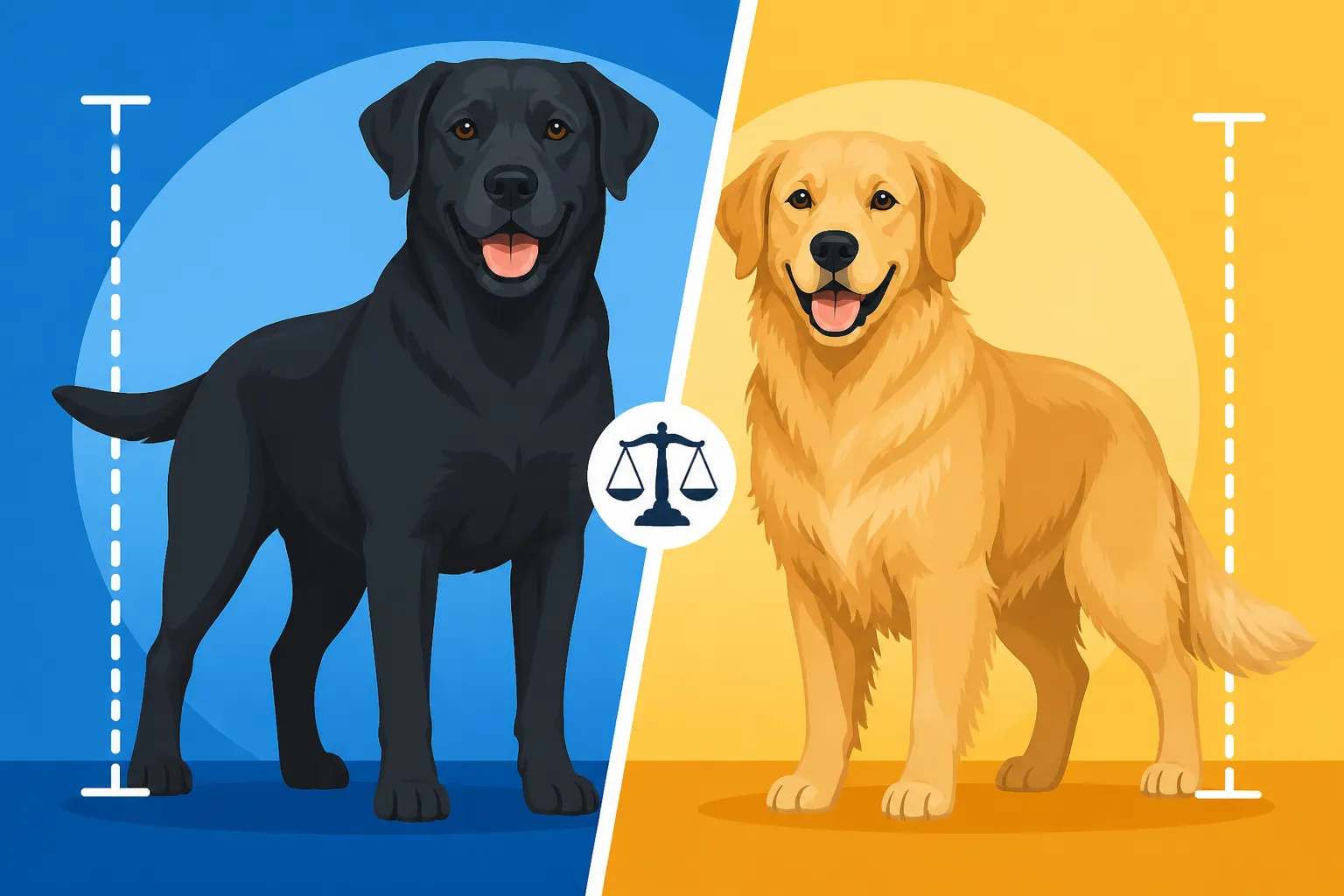
How Big Labradors Get Compared to Goldens
It's incredibly common for people to wonder about the size differences between two of America's most beloved breeds, the Labrador Retriever and the Golden Retriever. They often look quite similar at a glance, especially when you see them romping in the park, leading many to assume they're practically interchangeable in stature. However, there are some distinct variations in their build, weight, and overall proportions that can influence everything from the size of dog bed you buy to how much space they need in your home. This guide will walk you through the nuances of their physical standards, helping you understand how these magnificent dogs truly stack up against each other.
Unpacking the Labrador Retriever's Size and Build
Labrador Retrievers are renowned for their sturdy, athletic build. They were originally bred as working dogs, assisting fishermen with retrieving nets and escaped fish in icy waters, and that heritage is reflected in their powerful, well-muscled bodies. When you look at a Labrador, you're seeing a dog built for endurance, strength, and resilience. They tend to have a slightly more "blocky" or robust appearance compared to Goldens, with broader heads and thicker necks.
Typical Height and Weight for Male Labradors
According to the breed standard, a male Labrador Retriever typically stands between 22.5 to 24.5 inches tall at the shoulder (the highest point of the scapula, or shoulder blade). This height gives them a substantial presence. Weight-wise, male Labradors usually fall into the range of 65 to 80 pounds. This isn't just fluffy weight; it's dense muscle and bone, contributing to their impressive power. Think of a well-conditioned male Labrador as a canine athlete, ready for action. You can learn more about their overall dimensions in Labrador Size and Adult Proportions.
These figures are ideals, of course. Some individual males might be a little shorter or taller, a few pounds lighter or heavier, especially if they come from a "field line" which can sometimes be leaner, or a "show line" (often referred to as English Labs) which can be more heavily boned. The key is balance and proportion. A male Labrador should look strong, not bulky, with a visible tuck-up and defined waist when viewed from above.
Typical Height and Weight for Female Labradors
Female Labradors are generally a bit smaller and lighter than their male counterparts, exhibiting a more refined yet still powerful build. They typically stand between 21.5 to 23.5 inches tall at the shoulder. In terms of weight, female Labradors usually weigh in at 55 to 70 pounds. While they share the same sturdy characteristics as males, females often present a slightly more elegant profile.
Just like with males, these are average ranges. A healthy female Labrador should display the same athletic, balanced appearance as a male, just on a slightly smaller scale. Their powerful hindquarters and deep chest are still very much present, essential for their retrieving duties and active lifestyle. If you're observing a female Labrador puppy, tracking her growth against these standards can help ensure she's developing appropriately, alongside proper nutrition.
The Labrador's Muscular, Athletic Frame
The Labrador's overall conformation is one of power and agility. They have broad chests, strong, level toplines, and hindquarters that are well-angulated for propulsion. Their legs are strong and straight, ending in compact, webbed feet that are perfect for swimming. This isn't just about looking good; every aspect of their physical design serves a purpose. Their thick, "otter" tail acts as a rudder in the water, and their dense, water-repellent double coat provides insulation in cold conditions.
When you feel a Labrador, you'll notice their firm musculature. They're not delicate dogs; they're built to work hard and play hard. This robust frame also means they need appropriate exercise to maintain their conditioning and prevent issues like obesity, which can shorten their lifespan. Their physicality is a big part of The Labrador Retriever Breed Explained.
Decoding the Golden Retriever's Dimensions and Structure
Golden Retrievers, while equally beloved and also hailing from a retrieving background, present a subtly different picture in terms of size and build. They were bred to retrieve game birds gently, and their physical attributes reflect this. Goldens tend to have a more graceful, flowing outline compared to the Labrador's more rugged, blocky appearance. Their coat is a defining feature, long and flowing, adding to their perceived volume.
Typical Height and Weight for Male Goldens
Male Golden Retrievers generally stand between 23 to 24 inches tall at the shoulder. This puts them in a very similar height range to male Labradors, perhaps just a hair taller on average, but often within the same spectrum. Weight-wise, male Goldens typically weigh 65 to 75 pounds. Notice how this range is slightly narrower and often falls on the lower end compared to Labradors.
While they share similar numbers, the impression of size can differ due to their conformation. A Golden's longer coat can make them appear larger or more substantial than their underlying frame might suggest. They possess strength and athleticism, but with a touch more elegance in their lines.
Typical Height and Weight for Female Goldens
Female Golden Retrievers also follow the pattern of being slightly smaller than their male counterparts. They usually stand between 21.5 to 22.5 inches tall at the shoulder and weigh 55 to 65 pounds. Again, these figures are quite close to female Labradors, but often on the lighter side of the scale.
The female Golden Retriever maintains that characteristic graceful outline, often appearing a bit more lithe than a female Labrador. Their body structure is still powerful and athletic, capable of hours of activity, but with a distinct elegance, especially with their flowing coat.
The Golden's Graceful, Powerful Stature
Golden Retrievers possess a balanced, symmetrical, and powerful gait, demonstrating their athletic capability. Their build is often described as slightly lighter-boned than a Labrador's, with a body that is deeper than it is wide. Their head is broad, but often not as blocky as a Lab's, and they have a distinct, intelligent expression. The tail is carried level with the back, never curled, and feathered with longer hair.
Their hallmark, of course, is their rich, lustrous double coat. This dense coat is water-repellent and provides protection in various weather conditions, much like the Labrador's, but it's longer and requires more grooming. This extra hair can contribute to the visual perception of a larger dog, even if their underlying frame is comparable or slightly smaller. Both breeds are considered large, active dogs, and understanding their subtle differences can help you appreciate their unique qualities.
Direct Comparison: Labrador vs. Golden Size on Paper
When you lay out the numbers side-by-side, the similarities are striking, yet the differences become clear. Both breeds are solidly in the large dog category, but the Labrador often edges out the Golden in terms of sheer robustness and weight.
| Trait | Male Labrador Retriever | Female Labrador Retriever | Male Golden Retriever | Female Golden Retriever |
|---|---|---|---|---|
| Height | 22.5 – 24.5 inches (at shoulder) | 21.5 – 23.5 inches (at shoulder) | 23 – 24 inches (at shoulder) | 21.5 – 22.5 inches (at shoulder) |
| Weight | 65 – 80 pounds | 55 – 70 pounds | 65 – 75 pounds | 55 – 65 pounds |
| General Build | Sturdy, muscular, "blocky" | Sturdy, muscular, slightly more refined | Graceful, athletic, flowing lines | Graceful, athletic, elegant |
| Head Shape | Broader, more substantial | Broader, substantial | Broad, intelligent, slightly less blocky | Broad, intelligent, refined |
| Coat Type | Short, dense, water-repellent double coat | Short, dense, water-repellent double coat | Long, dense, feathered, water-repellent | Long, dense, feathered, water-repellent |
As you can see, the height ranges overlap significantly. It's in the weight category and the overall impression of their build where the distinction is most pronounced. Labradors tend to be heavier-boned and more compact, while Goldens can appear a bit more leggy or refined, despite similar heights. If you're picking out a dog bed, for example, a size suitable for a 75-pound Labrador might feel a little snugger than for a 75-pound Golden due to the Labrador's broader frame.
AKC Standards: Where the Numbers Lie
Both the American Kennel Club (AKC) and other international kennel clubs set specific standards that define the ideal characteristics of each breed, including size. For Labradors, the AKC standard emphasizes a strong, athletic dog that is "powerful and well-built." The height and weight ranges are strictly defined, and any significant deviation can be considered a fault in the show ring. Ideal Height for a Male Labrador Retriever and Ideal Height for a Female Labrador go into more detail on these measurements.
For Golden Retrievers, the AKC standard calls for a "symmetrical, powerful, active dog, sound and well put together." While their numbers are close to the Labrador's, the emphasis on symmetry and a "kindly expression" hints at a slightly different overall aesthetic. These standards are what breeders strive for and what judges evaluate, but it's important to remember that not every pet dog will fit these exact measurements perfectly, especially as dogs age or if they're not from show lines.
Visual Distinctions: Head Shape, Coat, and Tail
Beyond the tape measure and scale, there are clear visual cues that distinguish the two breeds. A Labrador's head is often described as broad and somewhat blocky, with a powerful muzzle. Their ears are moderately short and hang close to the head. Their tail is thick at the base, tapering to the tip, and often called an "otter tail" due to its shape and how it's carried.
Golden Retrievers, conversely, have a broader skull but often a more refined, tapering muzzle. Their expression is typically soft and intelligent. Their long, flowing coat is their most obvious differentiator, with feathering on the legs, tail, and chest. The tail itself is feathered and carried level with the back. Even their eyes often have a different "look"—Labs often having a keen, intense gaze, while Goldens often display a softer, more benevolent expression. For those often mixing them up, this is one of the reasons Why Labradors and Goldens Are Confused.
English vs. American Lines and Their Impact on Size
It's also worth noting that within the Labrador Retriever breed, there are commonly recognized "lines" that can affect size and build. "English" or "show line" Labradors tend to be stockier, with broader heads, heavier bone structure, and a generally more compact body. They are often closer to the upper end of the weight standard. On the other hand, "American" or "field line" Labradors are typically leaner, more athletic, with a lighter build and often longer legs, making them appear less bulky and sometimes a bit smaller in overall mass, even if their height is similar. This contributes to observations like Why English Labradors Look Heavier.
Golden Retrievers also have variations, though perhaps not as starkly delineated. There are American Goldens, Canadian Goldens, and English (or European) Goldens. English Goldens, for instance, are often lighter in coat color, have a slightly broader skull, and a somewhat stockier build than their American counterparts, making them visually closer to an English Labrador in general robustness, though still with their characteristic flowing coat. These internal breed variations mean that the exact size of an individual dog can vary quite a bit, even within the same breed.
Beyond the Numbers: Visual Cues and Influencing Factors
While breed standards provide excellent guidelines, they are just that – guidelines. The size of an individual Labrador or Golden Retriever can be influenced by a multitude of factors, some genetic, some environmental. Understanding these can help you better appreciate your dog's unique physical characteristics and ensure they are growing and developing in a healthy way.
Genetics and Parental Influence
The most significant factor determining a dog's eventual size is genetics. A puppy inherits its potential size from its parents. If both parents are large, well-within or at the upper end of their breed's standard, their puppies are likely to follow suit. Conversely, if the parents are on the smaller side of the standard, their offspring will likely be smaller as well. This is why a reputable breeder will be transparent about the size of their breeding dogs and can often give you a good estimate of a puppy's adult size.
Beyond just the parents, the genetic lineage plays a role. As mentioned earlier, the distinction between English/show lines and American/field lines in Labradors means that puppies from a field line, even if both parents are of standard size, might mature into a leaner, less weighty dog than a puppy from a show line. It's a fascinating interplay of genes that shapes each unique dog.
Nutrition and Growth Rate
Proper nutrition during puppyhood is absolutely critical for healthy growth and development. Feeding a high-quality, large-breed specific puppy food is often recommended for both Labradors and Goldens, as these formulas are designed to promote a slower, more controlled growth rate. Rapid growth, particularly in large breeds, can put undue stress on developing joints and lead to orthopedic issues like hip or elbow dysplasia later in life. This is a crucial point discussed in How Fast Growth Damages a Labrador's Joints.
Overfeeding, even with appropriate food, can also lead to excessive weight gain and stress on joints. Conversely, underfeeding can stunt growth and lead to nutritional deficiencies. It's a delicate balance. Monitoring your puppy's weight and body condition score, and adjusting their food intake as needed (often with guidance from your veterinarian or the feeding charts provided by brands like Chewy) is paramount. Feeding a Labrador Through Every Life Stage offers valuable insights into managing their diet.
Monitoring Healthy Growth in Puppies
For both Labrador and Golden Retriever puppies, closely monitoring their growth is essential. You want to see steady, not rapid, growth. A puppy should gain weight consistently, but should never look "chubby." You should be able to easily feel their ribs when you run your hands along their sides, without seeing them overtly. Their waist should be evident when viewed from above.
Regular vet check-ups are vital for this monitoring. Your vet can provide specific guidance on feeding amounts and assess your puppy's skeletal development. As they transition from puppy food to adult formulas (typically around 12-18 months), continued attention to their diet is important to prevent them from becoming overweight, a common issue for Labs in particular due to their intense food drive. Tools like a kitchen scale to measure food accurately, or a slow feeder bowl from Chewy, can be really helpful in maintaining a healthy weight. Understanding Checking a Labrador's Body Condition Score can also help you visually assess your dog's condition.
In conclusion, while Labradors and Golden Retrievers are very similar in height, Labradors generally carry more mass and have a more robust, blocky build. Golden Retrievers, while equally powerful, tend to present a more graceful and elegant outline, often appearing visually larger due to their abundant coats. Both are magnificent, large breeds, and understanding these subtle differences helps us appreciate the unique beauty and functional design of each.
Disclaimer
This article is for general informational purposes only and does not constitute professional advice. Laws, prices and regulations vary by location and change over time. Consult a qualified professional for guidance on your specific situation.