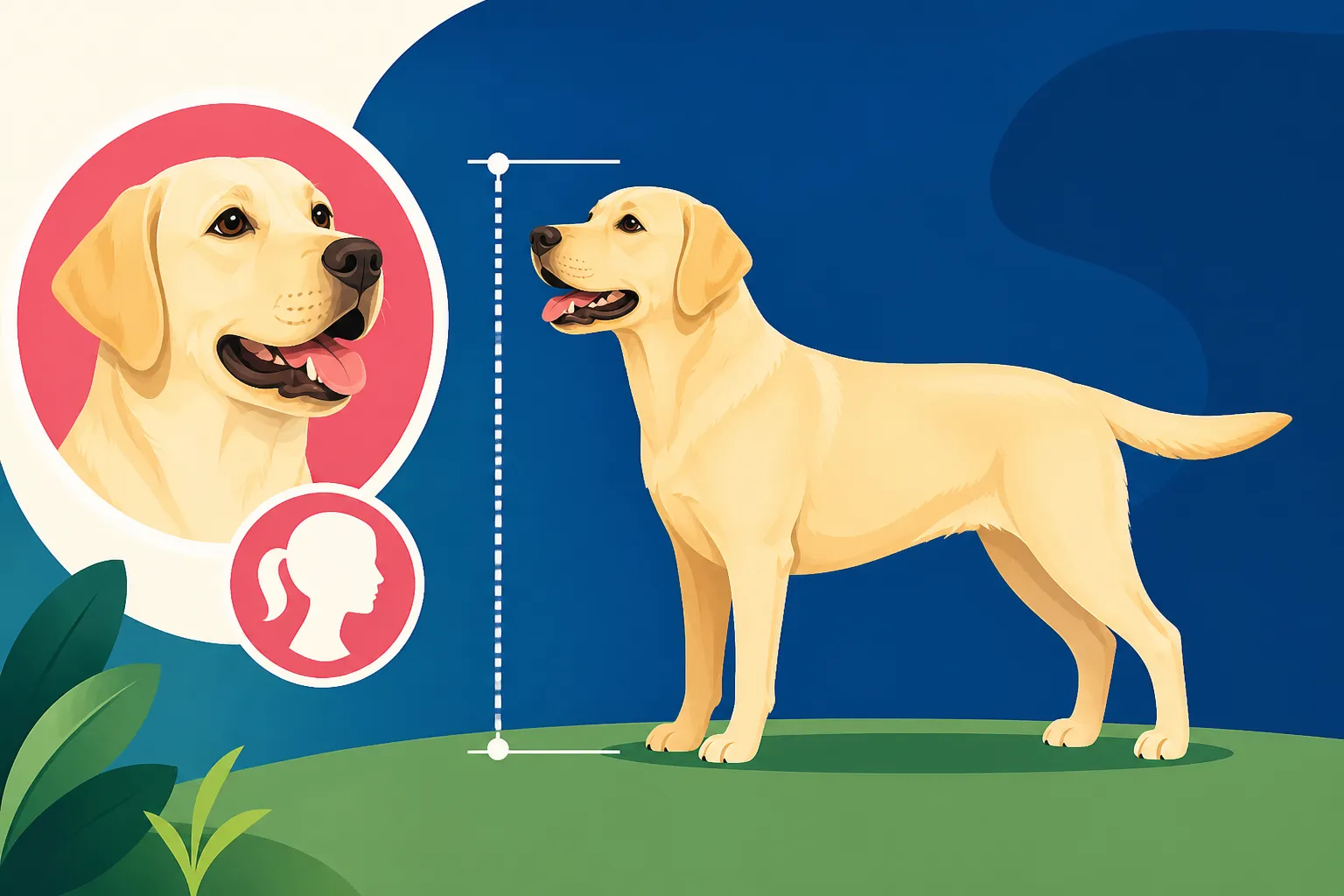
Ideal Height for a Female Labrador
It's incredibly common for new Labrador owners, and even seasoned ones, to find themselves scratching their heads when it comes to understanding just how big their beloved female Lab should be. You see pictures online, you meet dogs at the park, and everyone seems to have a slightly different idea of what a "typical" Labrador looks like. This guide is here to cut through the confusion and give you a clear, empathetic look at the ideal height for a female Labrador Retriever, why it matters, and what to expect as your own pup grows.
Understanding the Labrador Breed Standard for Females
When we talk about "ideal" height for any purebred dog, we're usually referring to the breed standard set by major kennel clubs. These standards aren't just arbitrary rules; they're blueprints designed to maintain the breed's historical traits, function, and overall health. For Labradors, these standards reflect their heritage as strong, agile working dogs capable of retrieving waterfowl for hours.
Why the Breed Standard Matters
For most of us who simply adore our Labradors as family companions, the breed standard might seem like something only competitive show breeders need to worry about. And honestly, for day-to-day life, you're absolutely right! Your Labrador's height isn't going to affect how much she loves you or how many squirrels she barks at in the yard.
However, the breed standard serves a critical purpose. It guides responsible breeders in selecting dogs that will produce healthy, functional offspring. It helps ensure that Labradors continue to possess the physical attributes necessary for their original work – things like a strong, athletic build, a specific coat type, and yes, an appropriate size that allows for endurance and agility. When a dog deviates too far from the standard, it can sometimes indicate issues with health, structure, or even temperament. So while your fluffy, slightly-too-tall Lab is perfect in your eyes, understanding the standard gives you insight into the breed's origins and optimal physical form.
Specific Height Requirements for Female Labradors
So, what exactly does the breed standard say about the height of a female Labrador? Let's break it down using the two most recognized kennel clubs: the American Kennel Club (AKC) and The Kennel Club (UK).
The measurement is always taken at the withers, which is the highest point of the shoulder blades, where the neck meets the back. This is generally considered the most stable point for measuring a dog's height.
- American Kennel Club (AKC) Standard for Females: The AKC specifies that a female Labrador Retriever should stand 21.5 to 22.5 inches (approximately 54.6 to 57.2 cm) at the withers.
- The Kennel Club (UK) Standard for Females: The UK standard is slightly different, stating a height of 21.5 to 22 inches (approximately 54 to 56 cm) for bitches (females).
As you can see, there's a slight overlap but also a subtle difference. American-bred Labradors (often referred to as American or Field Labradors) sometimes fall on the taller, leaner end of the spectrum compared to their English counterparts (English or Show Labradors), who tend to be a bit more compact and stocky. This difference is largely due to the emphasis each region places on different aspects of the breed's original function – field trial dogs needing more athleticism, show dogs needing to adhere strictly to conformation. You can learn more about these distinctions in our article English and American Labrador Types.
The Range in the Standard and What it Means
It’s important to note that both standards provide a range rather than a single, fixed number. This isn't just arbitrary; it acknowledges natural genetic variation within the breed and allows for a healthy diversity of individuals. It means that a female Labrador standing 21.5 inches is just as "correct" as one standing 22.5 inches (within the AKC standard).
This range also means that not every perfectly healthy, well-bred Labrador will hit the exact middle of the standard. If your female Lab is 22 inches tall, she's right in the sweet spot for both standards. If she's 23 inches, she's technically a bit tall for the AKC standard, but that doesn't necessarily mean there's anything wrong with her for a pet home. The goal of the standard is for dogs to be within this functional size range, not to produce clones.
Factors Influencing a Female Labrador's Height
While the breed standard gives us an ideal, several real-world factors can influence your female Labrador's ultimate height. It's a complex interplay of nature and nurture, and understanding these elements can help set realistic expectations for your own pup's growth.
Genetics and Parental Lines
Hands down, genetics play the biggest role in determining your Labrador's adult height. Just like in humans, tall parents tend to have tall offspring, and the same goes for our canine companions. When you choose a puppy from a reputable breeder, they should be able to provide information on the parents' heights, build, and even those of grandparents, giving you a good indication of what to expect.
Breeders who are aiming for the show ring will meticulously select dogs that closely adhere to The AKC Labrador Retriever Breed Standard, including height. Field line breeders might prioritize athleticism and working ability, which sometimes results in a slightly rangier build, potentially leading to a female on the taller end of the standard, or even just a touch over.
For example, if both your puppy's parents are on the taller side of the standard for their sex, it's very likely your female pup will also lean towards the upper end of the acceptable height range. Conversely, if her parents are more compact, she's likely to follow suit. This is why looking at the parents and understanding their lineage is so crucial when selecting a puppy.
Nutrition and Early Growth
What and how you feed your Labrador puppy during her crucial growth phases can absolutely impact her development, including her skeletal structure and ultimate height. This isn't to say you can make a genetically small dog tall, or vice versa, but improper nutrition can certainly hinder or accelerate growth in unhealthy ways.
Puppies, especially large breed puppies like Labradors, need a carefully balanced diet designed for their specific growth rate. Feeding a Large Breed Puppy Food for a Labrador is vital. These formulas are specifically designed to support slower, more controlled growth, which is essential for protecting developing joints and bones. Overfeeding, or feeding a regular adult dog food too early, can cause puppies to grow too quickly. While this might make them seem bigger faster, it puts undue stress on their soft, rapidly growing bones and joints, increasing the risk of orthopedic issues like Labrador Hip and Elbow Dysplasia later in life. It's far better for a Labrador to grow steadily than to hit her adult size at an accelerated pace.
Always follow the feeding guidelines on your chosen food and consult your vet to ensure your puppy is maintaining a healthy body condition. A lean puppy is a healthy puppy, and maintaining that ideal weight throughout growth is key.
Spay/Neuter Timing and Growth Plates
This is a factor that often surprises new owners. The timing of when a female Labrador is spayed can actually have an influence on her final adult height, albeit usually a subtle one.
Long bones in puppies have growth plates at their ends, which are areas of cartilage where new bone is formed. These plates gradually close and harden into solid bone as the dog matures. Sex hormones, produced by the ovaries in females, play a role in signaling these growth plates to close.
When a female Labrador is spayed before her growth plates have naturally closed (which typically happens around 12-18 months of age, though it varies), the removal of these hormone-producing organs can delay the closure of the growth plates. A delay in growth plate closure can, in some cases, result in the dog growing slightly taller than she otherwise would have. This is because the bones continue to lengthen for a longer period.
While the height difference might only be an inch or two, it's a recognized physiological effect. For this reason, many veterinarians and breeders now advocate for delaying spaying until a female Labrador is more skeletally mature, often past her first heat cycle or even closer to 18-24 months of age. This allows the natural hormonal processes to guide proper bone development and growth plate closure. Our article When to Spay a Female Labrador Retriever delves deeper into this important decision. You can also explore When a Labrador's Growth Plates Close for more specific information.
Measuring Your Female Labrador's Height Accurately
Knowing the breed standard is one thing, but actually getting an accurate measurement of your own furry friend can feel like a wrestling match. Trust me, it's not always easy, especially with an enthusiastic Labrador!
How to Measure at Home
Measuring your Labrador's height at home is definitely doable, though it might require a second set of hands and a good dose of patience (and treats!). Remember, we're measuring at the withers – the highest point of her shoulder blades, not the top of her head.
Here's a simple method:
- Find a Flat, Hard Surface: This is crucial for accuracy. Carpet can give you a false reading. A concrete patio or hardwood floor is ideal.
- Get Your Tools Ready: You'll need a measuring tape or a rigid measuring stick (like a yardstick or a carpenter's square) and a level or a flat ruler. If using a measuring tape, you'll also need a wall.
- Position Your Labrador: Have your Labrador stand squarely, with all four paws directly under her, not stretched out or tucked in. Her head should be in a natural, upright position, not looking up or down. This is where the second person and treats come in handy! One person can gently hold her in position, while the other measures.
- Measure at the Withers:
- Using a measuring stick/yardstick: Place the stick vertically behind her front leg, extending it up to her withers. Then, take your level or flat ruler and place it horizontally across the top of her withers, extending from the stick to the wall. Mark the spot on the stick where the level intersects it, and read the measurement.
- Using a wall and tape measure: Have your Labrador stand squarely against a wall. Take your level or flat ruler and place it horizontally across the top of her withers, keeping it parallel to the floor. Mark the spot on the wall where the bottom of the level touches. Then, use your measuring tape to measure from the floor to that mark on the wall.
- Take Multiple Measurements: Even the best-behaved Lab can shift slightly. Take a few measurements and average them to get the most accurate result.
Remember, the goal isn't perfect precision to the millimeter, but a close estimate that helps you understand where she falls in relation to the breed standard.
When to Measure and Growth Plate Closure
Your Labrador puppy will experience rapid growth in her first few months, then gradually slow down. She'll typically reach her full height by about 12 to 14 months of age, though some may continue to grow slightly taller until 18 months. Her growth plates generally close between 12 and 18 months, which is when her long bones stop lengthening.
While her height might be mostly set by 14 months, she will continue to "fill out" and gain muscle mass until she's about two or even three years old, particularly if she's a robust English-type Labrador. So, if your one-year-old female seems a bit leggy, don't worry – she's likely still got some developing to do in terms of body mass. Our article Labrador Size and Adult Proportions provides more details on this. It's often best to take your final height measurement once she's over 18 months to ensure her growth plates have definitely closed.
What If Your Labrador Falls Outside the Standard?
It's completely okay! For the vast majority of Labrador owners whose dogs are cherished family pets, falling slightly outside the breed standard's height range is absolutely nothing to worry about. Most purebred dogs, even those from excellent lines, aren't exact clones of the "ideal."
If your female Labrador is an inch taller or an inch shorter than the standard, it typically has no bearing on her health, temperament, or ability to be a wonderful companion. As long as she's otherwise healthy, happy, and well-proportioned, her exact height is really just a fun fact.
The only time it becomes a significant consideration is if you intend to show your Labrador in conformation events. In that competitive environment, being outside the height standard is often a disqualifying fault, meaning she wouldn't be able to compete for championship titles. But for the couch snuggles, the enthusiastic retrieves, and the unconditional love, her height is just part of what makes her uniquely her.
Why Height Matters (and Why It Doesn't for Pet Owners)
The conversation around "ideal height" can sometimes feel like it puts too much pressure on our beloved dogs. Let's clarify when height really matters, and when you can simply enjoy your Labrador for who she is.
Importance in the Show Ring
For breeders and owners deeply involved in the sport of dog showing, specifically conformation, adherence to the breed standard, including height, is paramount. Judges evaluate dogs based on how closely they conform to this written description. A female Labrador who is significantly over or under the specified height range (e.g., more than half an inch outside the AKC standard) would likely be disqualified from competition.
This strict adherence ensures that the breed's characteristics are preserved across generations, maintaining the specific form that was originally developed for the breed's function. It's about maintaining consistency and quality within the breed's physical representation. So, if your dream is to compete at Westminster, then yes, your female Labrador's height is a make-or-break detail. For everyone else, it’s far less critical.
Health Implications of Extreme Height/Size
While being an inch or two outside the standard is generally benign for a pet Labrador, consistently breeding for or having dogs that are extremely oversized can sometimes lead to health concerns. Larger, heavier dogs can put more strain on their joints, potentially exacerbating conditions like Labrador Hip and Elbow Dysplasia or increasing the risk of cruciate ligament tears. Rapid growth, often associated with pushing for larger size, can also contribute to developmental orthopedic diseases.
However, it's crucial to differentiate between a dog that is simply a bit taller than average and one that is genuinely "giant" for the breed. Most Labradors that fall just outside the standard height are perfectly healthy and experience no adverse effects related to their size. The emphasis should always be on healthy, proportionate growth and maintaining an ideal body condition score, rather than stressing over a specific inch. For concerns about your Labrador's health, always consult your veterinarian.
Practical Considerations for Home and Travel
Even if you're not showing your Labrador, her size can have some very practical implications for daily life. A taller or heavier female Labrador might require different gear or considerations than a smaller one.
For example, when choosing a crate, you'll need to ensure it's large enough for her to stand up, turn around, and lie down comfortably. A taller dog will definitely need a larger crate like those available on Chewy, so knowing her full adult height helps you select the right size. Our guide on What Size Crate a Labrador Needs offers more specific advice. Similarly, if you frequently travel with your Lab, Car Barriers and Seat Covers for a Labrador might need to be specifically sized for a larger dog, and some airlines have strict size and weight restrictions if flying in cargo.
Her size might also influence your choice of dog bed – a larger, orthopedic bed might be a better investment for a heavier dog to support her joints. Even mundane things like counter-surfing can be more challenging with a taller, more agile Labrador! While these aren't health or breed standard issues, they are practical realities that come with sharing your home with a large, athletic dog like a Labrador Retriever.
| Feature | AKC Standard (Female) | UK Kennel Club Standard (Female) | Implications for Pet Owners |
|---|---|---|---|
| Height at Withers | 21.5 – 22.5 inches (54.6-57.2 cm) | 21.5 – 22 inches (54-56 cm) | Benchmark for breed consistency; slight variations are normal. |
| Why it Matters | Show ring eligibility | Show ring eligibility | Not critical for health or companionship if slightly outside range. |
| Growth Factors | Genetics, nutrition, spay timing | Genetics, nutrition, spay timing | Proper nutrition & delayed spay can support healthy growth. |
| Practical Use | Crate size, travel gear, dog bed size | Crate size, travel gear, dog bed size | Plan for appropriate equipment for her adult size. |
In conclusion, while the breed standard offers a valuable guideline for the ideal height of a female Labrador, remember that your dog's true value lies in her companionship, health, and happiness. Enjoy her, measure her if you're curious, but most importantly, love her no matter where she lands on the measuring tape.
Disclaimer
This article is for general informational purposes only and does not constitute professional advice. Laws, prices and regulations vary by location and change over time. Consult a qualified professional for guidance on your specific situation.