Stopping a Labrador From Jumping Up
There is nothing quite like the overwhelming, bone-crushing enthusiasm of a Labrador Retriever welcoming you home. However, when that pure joy translates into seventy pounds of muscle launching directly into your chest, the love can feel a bit painful. If you are dealing with torn shirts, bruised knees, or the constant fear that your dog will knock over a visiting grandparent, you are far from alone. Jumping up is one of the most common, frustrating, and downright dangerous habits a Labrador owner faces. This comprehensive guide breaks down exactly why your Lab jumps, how we accidentally encourage the behavior, and the precise, step-by-step training methods you need to teach your dog polite, four-on-the-floor greetings once and for all.
The Psychology Behind Why Labradors Jump Up
To effectively address a behavioral issue, we must first look at the world through our dog’s eyes. Labradors do not jump up out of malice, dominance, or a desire to take over the household. In almost every case, jumping is born from a mix of natural canine social instincts, high emotional arousal, and a history of well-meaning human reinforcement.
Instinctual Greeting and Face-Level Communication
In canine social structures, dogs greet one another face-to-face. Puppies naturally lick the muzzles of adult dogs as a sign of respect, affection, and a request for food or attention. When a Labrador looks at a human, our faces are located anywhere from five to six feet in the air. From your Lab’s perspective, jumping up is simply the most efficient way to reach your face, smell your breath, and give you the close-up greeting their instincts demand.
Furthermore, Labradors were engineered for decades to work closely alongside human handlers. They possess a naturally social, human-centric temperament that makes them intensely eager to engage with us. When you walk through the front door after a long day at work, your dog’s physiological arousal spikes dramatically. Jumping becomes a physical outlet for that massive wave of happy energy. Understanding that your dog is jumping out of misdirected affection rather than stubbornness helps set an empathetic baseline for the training ahead.
Accidental Reinforcement and Reward History
One of the hardest truths for dog owners to accept is that we often teach our Labradors to jump up without realizing it. When your dog was an eight-pound, fluffy puppy, jumping up was cute. You likely leaned down, scooped them up, showered them with high-pitched praise, and gave them affection. In those early weeks, your puppy learned a crystal-clear rule: putting paws on humans makes wonderful things happen.
As your puppy grows into a heavy adolescent, the rules suddenly change, but nobody explained that to the dog. Even worse, adult humans are notoriously inconsistent. One day you might push your dog off while laughing, another day you might grab their paws and dance with them, and on a stressful Tuesday when you are wearing work clothes, you might yell at them to sit down. To a Labrador, even negative attention—like pushing them away, making eye contact, or scolding them—is still attention. If jumping gets a response, the behavior is reinforced, making Why a Labrador Jumps on Every Visitor a daily reality in your home.
Excess Energy and Arousal Spikes
Labradors are high-energy working dogs, particularly during their juvenile and adolescent stages. When a young Lab does not receive sufficient physical exercise or mental stimulation throughout the day, their baseline stress and arousal levels naturally hover higher than normal. When an exciting event occurs—such as a family member returning home or a visitor ringing the doorbell—that pent-up energy explodes in the form of jumping, spinning, and barking.
If your dog is spending long stretches of time in a crate or isolated room without structured physical outlets, asking them to remain calm during a greeting is setting them up to fail. Addressing jumping requires a holistic look at your dog’s daily routine. Before you can expect emotional control at the front door, you must ensure their physical and cognitive needs are met through structured exercise, sniffing walks, and interactive puzzle toys.
Immediate Management Strategies to Prevent Jumping Habits
Training a new behavior takes time, repetition, and patience. While you are working on building solid obedience commands, you must implement immediate management tools. Every single time your Labrador jumps up and succeeds in getting attention, the unwanted habit becomes more deeply ingrained. Management prevents your dog from practicing the mistake while you work on the solution.
The Four-on-the-Floor Rule
The cornerstone of stopping jumping is establishing a strict household policy: no human attention, eye contact, physical touch, or verbal interaction happens unless all four of the dog’s paws are planted firmly on the ground. This is known as the “Four-on-the-Floor” rule, and it must be applied universally across every member of the family and every guest who enters your home.
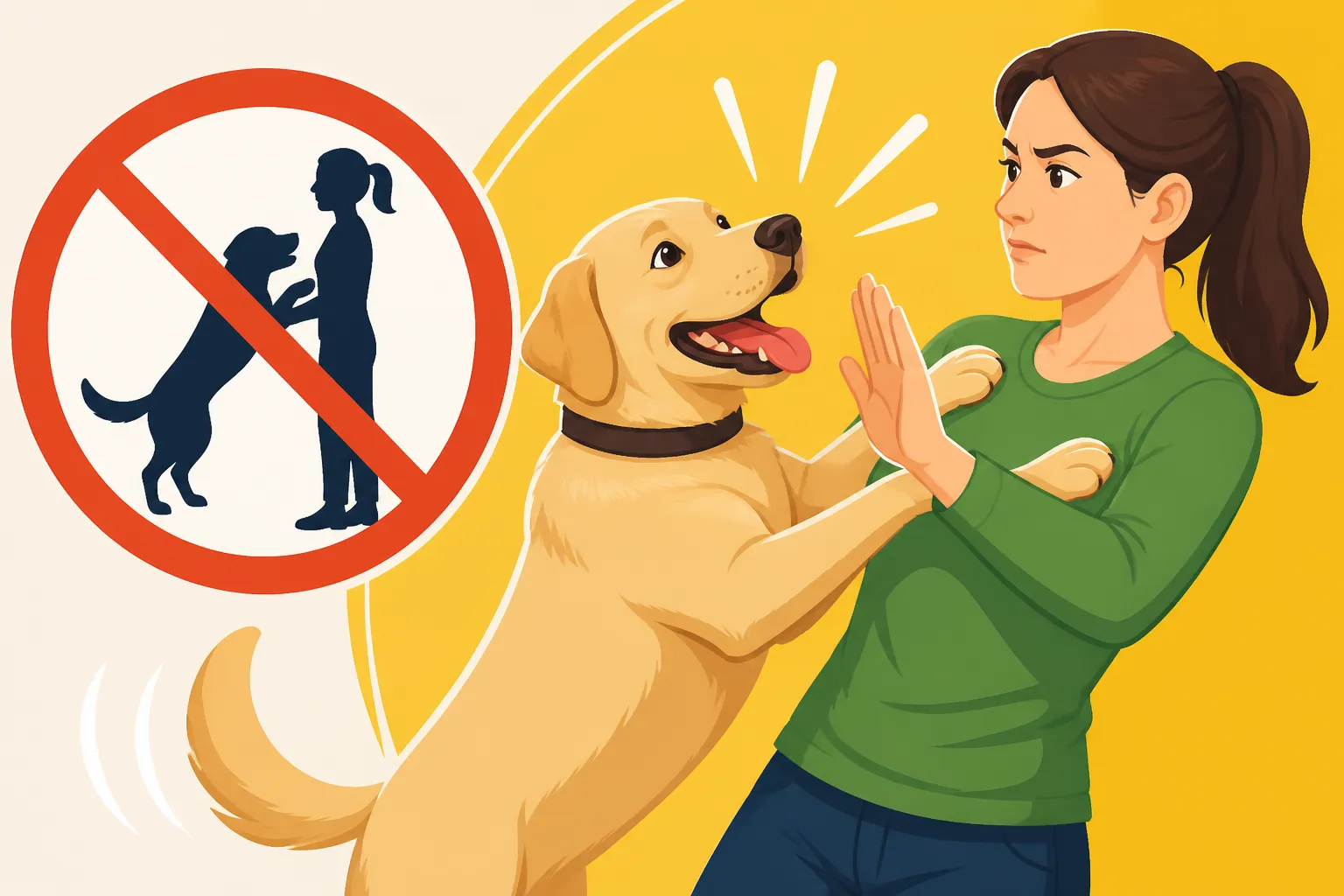
When you walk into a room and your Labrador jumps up, you must instantly transform into a statue. Turn your back, fold your arms across your chest, look up at the ceiling, and remain completely silent. Do not say “no,” do not push the dog away with your hands, and do not make eye contact. The moment all four paws touch the floor, immediately soften your posture and offer gentle praise or a low-value treat. If the dog leaps up again the second you lean down, turn into a statue again instantly.
Using Barriers and Leashes at the Door
Expecting an overly excited adolescent Labrador to exercise perfect self-control when the doorbell rings is often unrealistic in the early stages of training. Utilizing physical management tools keeps everyone safe and prevents bad habits from occurring. Baby gates, exercise pens, and tether stations are priceless assets when managing an overeager greeter.
Setting up a temporary baby gate that keeps your dog restricted to a hallway or living room away from the front door gives them space to observe arrivals without having physical access to guests. Alternatively, keeping a light slip leash or standard six-foot lead near the front door allows you to step on the leash or hold your dog at a comfortable distance before opening the door. If you are looking for reliable leashes, heavy-duty tethers, or adjustable gates, checking options on Amazon can help you quickly set up effective entry management barriers at home.
Environmental Enrichment and Calming Outlets
Because jumping is powered by high emotional arousal, replacing the physical act of jumping with an engaging, calming activity can dramatically reduce greeting stress. Licking and sniffing are naturally self-soothing behaviors for dogs that help lower heart rates and reduce cortisol levels.
When you know guests are arriving, prepare a stuffed frozen lick mat or a long-lasting chew ahead of time. As the door opens, direct your Labrador toward their dog bed and hand them their high-value chew, or toss a handful of kibble onto a snuffle mat. By channeling their immediate energy into a nose-based activity, you transform a frantic greeting into a quiet, grounded exercise.
| Strategy | Primary Objective | Best Used For |
|---|---|---|
| Turn-and-Ignore | Removes all attention to extinguish jumping | Everyday greetings with household members |
| Physical Tethering / Leashes | Prevents physical contact and maintains control | High-arousal visitor arrivals at the front door |
| Incompatible Behaviors (Sit/Place) | Replaces jumping with a clear, rewarded task | Dogs with basic obedience foundations |
| Scatter Feeding | Lowers arousal through nose work and foraging | Unexpected callers, delivery drivers, high-stress moments |
Step-by-Step Training Techniques for Polite Greetings
Management keeps the peace, but structured training is what alters your dog’s long-term behavior. The goal is to teach your Labrador that polite behavior earns far greater rewards than chaotic leaping ever could. By systematically teaching your dog what to do, you eliminate the confusion surrounding what not to do.
The Turn-and-Ignore Protocol
The Turn-and-Ignore protocol is the foundational drill for breaking the jumping habit with household members. It requires absolute consistency and zero emotional reaction from you. Practice this drill daily during quiet moments so your dog learns the mechanic before high-stakes situations arise.
- Enter the Room: Walk through an interior door or the front door while keeping your body neutral and relaxed.
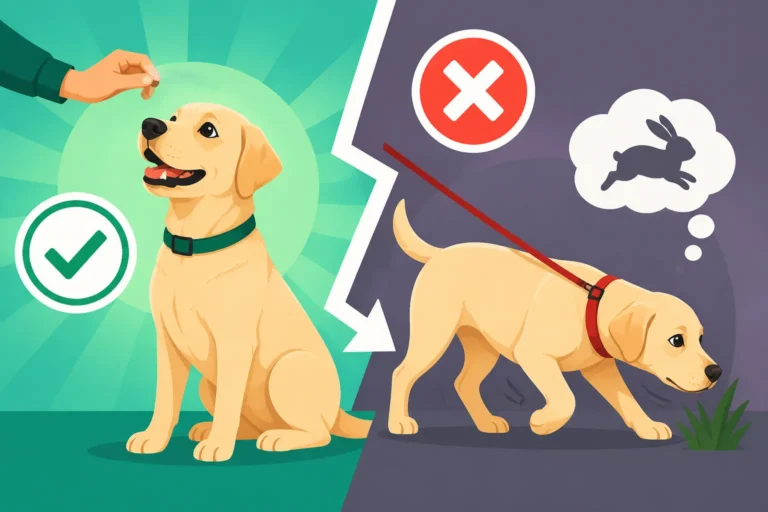
- Observe the Dog: If your Labrador approaches calmly with four paws on the ground, drop a high-value treat to the floor and offer gentle praise.
- Execute the Turn: If your dog attempts to leap up, immediately turn 180 degrees away from them, tucking your arms to your chest.
- Wait for the Reset: Stand completely still until the dog lowers themselves back to the floor.
- Reward the Pause: The second all four paws hit the ground, mark the moment with a word like “Yes!” and toss a treat onto the floor between their front paws.
- Repeat: If the dog jumps again as you reach down, immediately repeat the turn. Continue until the dog realizes that jumping causes you to disappear, while staying grounded makes treats rain down.
Teaching an Incompatible Behavior Like Sit
It is physically impossible for a Labrador to sit and jump at the same time. Teaching your dog that a automatic “Sit” is the universal key that unlocks human attention, greetings, and doors is one of the most effective ways of Teaching a Labrador to Greet Politely.
Start by practicing your dog’s “Sit” command in low-distraction environments like the living room. Once the response is crisp, transition to greeting scenarios. Approach your dog on a leash; if they sit, immediately drop down to their eye level, offer soft affection, and feed a treat. If their hind end lifts off the carpet, stand up straight, take two steps back, and wait. Over time, your dog will begin offering an automatic sit the second a person approaches, realizing that sitting is the fastest way to get pet.
The Scatter Feed Technique for High-Excitement Moments
Sometimes, despite your best efforts, a Labrador’s excitement level crosses the threshold where they simply cannot process verbal commands like “Sit.” In these moments of extreme arousal, the Scatter Feed technique acts as an immediate circuit breaker.
Keep a small bowl of low-calorie, smelly training treats near your entryway. As you step through the door—or right as a guest enters—say the word “Find it!” in a calm, clear voice and scatter a generous handful of treats directly onto the floor. Your Labrador’s head will drop to the ground instantly to forage for the food. Because their nose is active and their head is low, their brain shifts from a high-arousal jumping state into a methodical, calm tracking state. By the time they finish eating the treats, their initial surge of adrenaline has passed, allowing for a far calmer interaction.
Handling Visitors and Real-World Scenarios
It is one thing to train your Labrador to greet you calmly when you come home from grocery shopping; it is an entirely different challenge when exciting visitors come to the door or when strangers approach you on neighborhood walks. Real-world scenarios introduce unpredictable variables, requiring dedicated management strategies.
Preparing Guests Before They Enter
Visitors are often the biggest obstacle to a dog owner’s training progress. Well-meaning friends frequently say things like, “Oh, I don’t mind! I love dogs!” as your seventy-pound Labrador coats their jacket in mud. You must advocate for your dog’s training and set strict boundaries with human guests before they step across your threshold.
Send a quick text message to visitors before they arrive, outlining the house rules clearly. Ask them to ignore the dog entirely for the first three to five minutes—no eye contact, no speaking, and no petting. Explain that if the dog approaches, the guest should keep their hands high and turn away. If you feel like you need extra guidance on structured obedience routines to show your family, exploring comprehensive online dog training platforms like BAXTER & Bella can provide step-by-step video modules that make household alignment far easier.
Managing Leash Jumping on Public Walks
Jumping does not only happen at the front door; it frequently occurs on walks when passing neighbors, children, or other dog walkers. A leaping Labrador on a standard collar can easily pull you off balance or frighten passersby. Mastering Door Manners for an Excited Labrador naturally translates to better control outdoors.
When walking, always stay attentive to your surroundings. If you see a neighbor approaching, move your dog to the outer edge of the sidewalk or step several feet onto a grassy median to create distance. Put your dog in a sit-stay, placing your foot loosely on the leash lead so that if the dog attempts to leap up, the leash mechanically prevents them from lifting their front feet off the ground. Reward your dog continuously with small treats for maintaining focus on you as the distraction walks past. If your dog struggles with pulling or lunging on walks, utilizing specialized tools detailed in guides on Front-Clip Harnesses on a Strong Labrador or Stopping a Labrador From Pulling on Leash can offer additional physical leverage.
Training Children and Vulnerable Family Members
A jumping Labrador presents a real safety hazard for young children, elderly relatives, or individuals with mobility challenges. A enthusiastic bump from an adolescent Lab can easily send a toddler tumbling. Managing these interactions requires double the vigilance and strict environmental controls.
Never leave a young child unattended with a Labrador who is actively working through a jumping habit. Teach children how to execute “The Tree pose” whenever the dog becomes overly bouncy: feet together, hands folded under their chin, eyes looking up at the sky, and standing completely still. Dogs quickly lose interest in moving statues. For elderly family members, ensure the dog is kept securely on a short lead or behind a sturdy gate until the initial greeting excitement has fully dissipated. For further safety strategies surrounding younger family members, review guidelines on Teaching Children to Handle a Labrador.
Comparing Greeting Management Methods
Different training scenarios require different tools and protocols. Depending on whether you are dealing with a routine evening arrival or an unexpected repair technician knocking on the door, your approach will shift. The table below outlines how common management and training protocols compare in practical settings.
| Method | Setup Difficulty | Consistency Needed | Success Rate | Ideal Scenario |
|---|---|---|---|---|
| Turn-and-Ignore | Low | Extremely High | Moderate to High | Daily family member arrivals |
| Automatic Sit | Medium | High | High | Structured visitor greetings |
| Door Tethers / Gates | Low | Low | 100% (Immediate) | Delivery workers, service personnel |
| Scatter Feeding | Very Low | Low to Medium | High | High-excitement, fast-paced entries |
| Foot-on-Leash Control | Low | Medium | High | Outdoor public encounters |
Active Training vs. Environmental Management
It is critical to distinguish between active training methods and environmental management strategies. Active training—such as teaching an automatic sit or building a solid recall—rewires your dog’s decision-making process over time. It requires mental energy, repetition, high-value rewards, and steady patience.
Environmental management, on the other hand, relies on physical barriers, crates, and leashes to prevent the mistake from happening in the first place. Management requires zero learning from the dog. While active training is the ultimate long-term goal, relying solely on training during high-arousal moments without management leads to burnout. Successful dog owners weave active training and management together seamlessly every single day.
Gear and Tools to Assist Training Progress
Equipping yourself with the proper gear can dramatically accelerate your training timeline and protect your body while your Labrador learns manners. Having high-quality tools within arm’s reach around your house ensures you are always prepared for unexpected doorbell rings.
Key training tools include:
* Treat Pouches: Wearing a dedicated treat pouch ensures you can reward polite behavior immediately within the critical one-second learning window.
* Front-Clip Harnesses: A sturdy front-attaching harness redirects your dog’s forward momentum back toward you if they attempt to launch forward.
* Stationary Tethers: Securing a eye-bolt tether near your entryway allows you to clip your dog’s leash in place before answering the door.
* Short Traffic Leads: A short lead attached to your dog’s harness indoors allows you to gently guide them away from visitors without grabbing their collar.
If you are looking to stock up on these supplies, shopping online across Amazon offers a vast range of durable harnesses, tethers, and reward pouches suited for strong working breeds.
Consistency and Long-Term Success Strategies
The secret to stopping a Labrador from jumping up does not lie in a magic trick or a single tool; it lies in absolute human consistency. Dogs are incredible pattern-recognition machines. If a behavior works one out of ten times, they will continue trying it hundreds of times over.
Aligning the Entire Household
The single most common reason jumping protocols fail is household inconsistency. If Dad enforces the Turn-and-Ignore rule, but Mom allows the dog to place their paws on her shoulders, and the kids actively roughhouse with the dog when they get home from school, the dog becomes deeply confused. In behavioral terms, this creates an “intermittent reinforcement schedule,” which actually makes the jumping habit far stronger and more resistant to extinction.
Call a family meeting to discuss the training rules explicitly. Ensure every member of the household understands the protocol, agrees to keep their hands off a jumping dog, and knows how to deliver rewards when all four paws are grounded. When every human in the dog’s life speaks the exact same body language and enforces identical boundaries, your Labrador’s progress will surge forward rapidly.
Troubleshooting Relapses and Persistent Jumping
Training is rarely a straight line. You will likely experience periods where your Labrador makes incredible progress for two weeks, only to have a sudden behavioral regression during a stormy evening or a busy holiday gathering. Adolescence, in particular, brings dramatic shifts in impulse control. If you notice your dog regressing during these months, reviewing strategies for Handling a Labrador Between Six and Eighteen Months can help put those hormonal shifts in perspective.
If your dog experiences a relapse, do not panic or resort to harsh corrections. Simply take a step back in your training criteria:
* Increase the distance between your dog and the front door using gates or leashes.
* Upgrade the value of your reward treats to high-value real meat or cheese to compete with the distraction.
* Revisit basic puppy drills, focusing on calming exercises like settled crate rests—referencing guides on Settling a Labrador Puppy Who Cries in the Crate can help reinforce boundary training techniques.
* Ensure your dog’s physical exercise and enrichment routines are being met fully before high-stress events.
If your dog struggles with reactivity, or if you suspect their jumping is driven by severe separation anxiety or aggression rather than overarousal, seek out a certified positive-reinforcement professional behaviorist. Professional guidance from qualified trainers, such as those accessible through structured online platforms like BAXTER & Bella, can offer custom assessments tailored directly to your home layout and family dynamic.
With patience, clear boundaries, consistent human responses, and plenty of positive reinforcement, your enthusiastic Labrador will learn that keeping all four paws planted on the carpet is the absolute best way to win your love, attention, and treats every single day.
Disclaimer
This article is for general informational purposes only and does not constitute professional advice. Laws, prices and regulations vary by location and change over time. Consult a qualified professional for guidance on your specific situation.