First Signs of Retinal Atrophy in a Labrador
It’s incredibly distressing to notice your vibrant Labrador, usually so confident and graceful, suddenly hesitant in dimly lit rooms or bumping into familiar furniture. These subtle shifts can be baffling, leaving you to wonder if it's just an odd quirk or something more serious. Often, these are the very first, easily overlooked indicators of Progressive Retinal Atrophy (PRA), a condition that can slowly steal your beloved companion's eyesight. This guide is here to demystify those confusing early signs, helping you recognize them, understand their implications, and ultimately take proactive steps to support your Labrador through this challenging journey.
Understanding Progressive Retinal Atrophy in Labradors
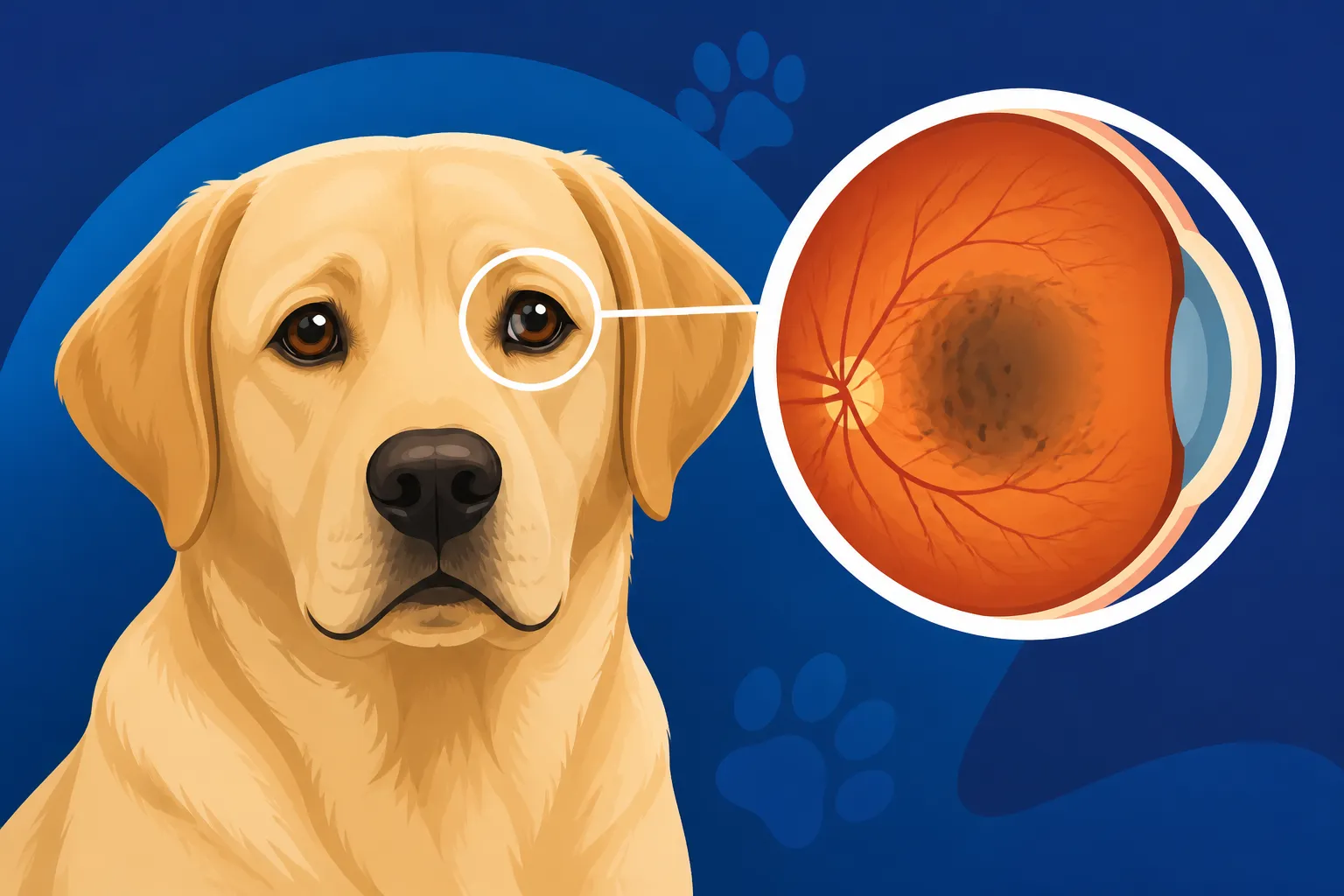
Progressive Retinal Atrophy, or PRA, isn’t just one single disease but rather a group of genetic disorders that affect the retina, the light-sensitive tissue at the back of your Labrador's eye. Think of the retina like the film in an old camera; it captures light and sends those images to the brain. In dogs with PRA, the cells in this "film" slowly degenerate over time, leading to eventual blindness. It’s a genetic ticking clock, sadly.
What makes PRA so particularly heartbreaking for Labrador owners is that this breed, along with others like Golden Retrievers, Cockapoos, and Irish Setters, is unfortunately predisposed to certain forms of the condition. You bring home this lively, intelligent puppy, full of potential, and it's hard to imagine something as fundamental as their vision being compromised later on. The word "progressive" is key here – it means the condition gets worse over time, not suddenly appearing overnight.
There are several types of PRA, but the most common form affecting Labradors is often referred to as PRA-prcd (progressive rod-cone degeneration). This particular variant usually starts with the degeneration of the rod cells, which are responsible for vision in low light. Later, the cone cells, which handle bright light and color vision, also begin to fail. It’s like watching a dimmer switch slowly turn down, first in the dark, then eventually in full daylight. This gradual nature is precisely why the initial signs can be so easy to miss or dismiss as simple clumsiness or age-related quirks. Many breeders now offer genetic testing to identify carriers or affected dogs, a crucial step in preventing the spread of this condition. For more detailed information, you can delve into Progressive Retinal Atrophy in Labradors.
Why Labradors Are Particularly Susceptible
The Labrador Retriever's genetic makeup, while contributing to their many wonderful traits like their friendly demeanor and strong retrieving drive, also carries a predisposition for certain health conditions, including various eye diseases. PRA is one of those inherited conditions that has been identified through extensive research. It's often passed down through a recessive gene, meaning a dog can be a carrier and show no signs of the disease themselves, but if bred with another carrier, their offspring could be affected. This is why responsible breeders place such a high emphasis on Genetic Panels Worth Running on a Labrador and OFA eye clearances for their breeding stock.
It’s not fair, is it? We try our best to get our dogs from good lines, and still, these things can emerge. Knowing the genetic basis, however, empowers us as owners to ask the right questions of breeders and to be vigilant about monitoring our own dogs for any early indications. It's a heavy responsibility, but one we gladly bear for our furry family members.
The Progression of PRA in Your Labrador's Eyes
As PRA progresses, it systematically targets the photoreceptor cells in the retina. Initially, it's the rod cells that are affected. These are the workhorses of night vision, allowing your Labrador to navigate in dim light. When they start to degenerate, your dog effectively becomes "night blind." Imagine trying to walk around your house in the dark without turning on any lights – that's what your Labrador might be experiencing.
Over months or even years, the cone cells, responsible for color and sharp daytime vision, will also succumb to the degeneration. This means that while night vision is the first to go, daytime vision will eventually follow suit. The pace can vary between individual dogs and different types of PRA, but the outcome is, unfortunately, usually complete blindness. It’s a slow, often imperceptible erosion of their world, which can be heartbreaking to witness. Understanding How Fast Labrador PRA Progresses can help you set expectations and prepare for future challenges.
Spotting the Earliest Signs: The "Night Blindness" Phase
The most common and earliest manifestation of PRA is usually "night blindness," medically known as nyctalopia. This isn't a sudden onset, but a gradual decline that you might initially dismiss or attribute to your Labrador simply being tired or clumsy. It's the kind of thing that makes you pause and wonder, "Did he just trip on nothing?" or "Why is he so hesitant to go outside after sunset?"
Your Labrador's world, which used to be easily navigable even in low light, slowly becomes a minefield of unseen obstacles. They might start to rely more heavily on their other senses, like their incredible nose, to compensate. This is where your careful observation becomes paramount.
Difficulty Navigating in Dim Light
One of the absolute first things you might notice is a change in your Labrador’s behavior when the light fades. As evening approaches, or when moving from a brightly lit room into a darker hallway, you might see them:
- Hesitating at thresholds: They might pause longer before entering a dimly lit room or going from outside to inside at dusk.
- Bumping into familiar objects: That coffee table they've always navigated perfectly? Suddenly, they're walking into it in the evening. Same goes for doorframes or furniture that hasn't moved. This isn't usually a hard crash, but a soft, hesitant bump.
- Clumsiness, especially outdoors: When you take them out for their last potty break after sunset, they might be slower, stumble more, or seem less certain of their footing on uneven ground in the yard.
- Reliance on you: They might stick closer to your legs in low-light situations, using you as a guide.
It's natural to think, "Oh, he's just getting older," or "He's distracted." But if these incidents become more frequent, especially consistently in low-light conditions, it's a significant red flag.
Behavioral Changes and "Owl Eyes"
Beyond just physical clumsiness, you might pick up on more subtle behavioral cues that indicate your Labrador is struggling with their night vision:
- Reluctance to go out at night: If your Lab, who usually loves their evening strolls, suddenly seems less enthusiastic or even outright hesitant to step outside into the dark, it could be that the lack of light makes them feel insecure.
- Increased clinginess: In dimly lit rooms or at night, they might become more "velcro" – sticking closer to you, bumping into your legs, or seeking more physical contact. This is their way of seeking reassurance and using your presence as a guide.
- Pupil dilation (Owl Eyes): This is a key visual sign. In an attempt to gather more light, a dog with early PRA will often have abnormally dilated pupils, especially in dim conditions. Their eyes might appear larger and darker than usual, sometimes described as having an "owl-like" appearance.
- Increased eye shine: If you shine a flashlight into their eyes in the dark, you might notice a more intense or greenish-yellow reflection (known as tapetal hyper-reflectivity) than before. This is because the retina is thinning, making the reflective layer behind it more prominent.
It's important to remember that Labs are incredibly stoic animals, and they are masters at adapting. They learn to compensate for their vision loss by sharpening their other senses, so you might not see overt signs of distress. However, their patterns will change. You might notice your dog's typical enthusiasm waning in situations that require good vision, or a cautiousness creeping into their movements. For advice on subtle signs of discomfort, you might find our guide on Reading Pain in a Stoic Labrador helpful, as vision loss can lead to anxiety and insecurity.
Utilizing a Simple Home Test
If you suspect night blindness, here's a simple, low-stress test you can try at home:
- Set the scene: Choose a familiar room in your house, perhaps the living room, where your Labrador is comfortable.
- Dim the lights gradually: As dusk falls or by slowly turning down the lights, make the room progressively darker, simulating low-light conditions. Ensure there are a few familiar objects (like a chair or a footrest) in the dog's path, but nothing that could cause real harm if bumped.
- Observe: Watch your Labrador as they move around. Do they hesitate? Do they slow down? Do they bump into objects they usually avoid?
- Introduce a new, but safe, obstacle: In a moderately dim setting (not pitch black), place a soft, non-threatening object (like a laundry basket or a pillow) in their usual path and observe their reaction. Do they notice it or bump into it?
Perform this test calmly, without making your dog feel anxious. The goal is observation, not stress. If you consistently notice difficulties, it's definitely time for a veterinary consultation.
Subtler Visual and Behavioral Clues as PRA Progresses
While night blindness is typically the first phase of PRA, the condition doesn't stop there. As the disease advances, the degeneration starts to affect the cone cells, which are responsible for daytime vision, color perception, and fine detail. This means that even in bright light, your Labrador's vision will continue to decline, leading to a new set of clues that can be equally as subtle.
It's common for owners to mistake these later signs for general aging, especially since Labradors have a tendency to be quite adaptable. You might think your dog is just "slowing down" or "getting forgetful," when in reality, they're losing their ability to see their world clearly.
Daytime Vision Decline and Coordination Issues
As PRA progresses beyond just night blindness, your Labrador will start to experience challenges with their vision even during the day:
- Difficulty tracking objects: You might notice they struggle to follow a fast-moving ball in the yard, even in bright sunshine. Their retrieves might become less precise, or they might miss catching treats tossed to them.
- Stumbling on uneven terrain: On walks, they might hesitate or stumble more often on curbs, steps, or uneven ground. What was once a confident stride might become more tentative. This can be especially noticeable on trails or during hikes.
- Changes in stair navigation: Going up and down stairs, particularly those with contrasting colors or patterns, can become a challenge. They might pause, place their paws more deliberately, or even start avoiding stairs altogether.
- Increased caution in new environments: If you take your Labrador to a new park or a friend's house, they might be noticeably more hesitant, stick close to you, or move with an unusual slowness, relying on your presence and their nose to map out the unfamiliar territory.
These changes can sometimes be so gradual that you might not even pinpoint them until they're quite pronounced. It's a creeping loss of confidence that mirrors their creeping loss of sight.
Increased Reliance on Other Senses and Anxiety
A Labrador's brain is incredibly good at compensating. As their vision fades, they naturally start to lean more heavily on their powerful sense of smell and their keen hearing. You might notice them:
- Sniffing more intensely: On walks, their nose might be glued to the ground more than usual, gathering information that their eyes can no longer provide.
- Reacting more to sounds: They might startle more easily at unexpected noises, or turn their head sharply towards sounds you might not even register, using their ears to locate objects or people.
- Changes in social interaction: A dog who was once outgoing and eager to greet others might become more reserved or cautious. They might need to sniff a person or another dog thoroughly before feeling comfortable, as visual cues are no longer sufficient.
- Anxiety when objects move: If you rearrange furniture, or if a new object is brought into the house, they might seem stressed or disoriented until they’ve had a chance to sniff and explore the new layout. Even simple things like a laundry basket being moved can cause momentary confusion.
- Pupils appear constantly dilated: As the disease progresses, even in bright light, their pupils might appear abnormally large, constantly trying to let in as much light as possible to compensate for the failing retina. This can make their eyes look glassy or dark.
- Cloudiness or dullness of eyes (later stages): While not an early sign, eventually, some Labs with advanced PRA might develop a secondary cataract or the tapetal reflection can become so prominent that the eye takes on a hazy or dull appearance. This is typically a much later stage, after significant vision loss has already occurred.
It’s truly difficult to watch your dog lose their independence, but understanding that these behaviors stem from their declining vision, rather than stubbornness or disobedience, allows you to respond with patience and empathy. Many of these behaviors are also seen in general aging. Our article on Caring for a Senior Labrador offers broader advice that can also be applied to a visually impaired senior dog.
When to Seek Veterinary Advice
If you notice any combination of these signs, particularly the early night blindness, it’s imperative to schedule an appointment with your veterinarian as soon as possible. Even though PRA is progressive, early diagnosis allows you to plan, adapt your home environment, and ensure your Labrador receives the best possible supportive care.
Do not wait for obvious signs of complete blindness, as by that point, the disease will be quite advanced. Your vet is the first port of call, and they can conduct initial eye examinations to rule out other common Labrador Eye Conditions and Vision Loss or refer you to a specialist.
When to See the Vet and What to Expect
Noticing any changes in your Labrador’s vision, no matter how subtle, should prompt an immediate call to your veterinarian. While PRA is not curable, early diagnosis is invaluable for managing the condition, adapting your dog’s environment, and preparing both of you for the journey ahead. It's truly a situation where being proactive makes all the difference for your dog's comfort and well-being.
It’s completely normal to feel a surge of worry and even a bit of denial when you suspect something is wrong with your dog’s vision. But remember, your vet is there to help guide you through these concerns.
Initial Veterinary Examination and Referral
When you first bring your Labrador to your general practice veterinarian with concerns about their vision, the vet will conduct a thorough general health check-up, alongside a basic ophthalmic (eye) examination. This will typically involve:
- Observing eye structure: Checking for any obvious abnormalities, redness, discharge, or injuries.
- Pupillary Light Reflex (PLR): Shining a light into their eyes to see how the pupils constrict. This can indicate if the light-sensing pathways are working.
- Menace Response: Moving a hand quickly towards the eye (without touching) to see if the dog blinks. This assesses a basic visual reflex.
- Cotton Ball Test: Dropping cotton balls (which make no sound) to see if the dog visually tracks them.
While your regular vet can often identify significant issues, diagnosing PRA usually requires the specialized equipment and expertise of a board-certified veterinary ophthalmologist. Your vet will likely recommend a referral to one of these specialists in your area. This isn't a sign that your regular vet isn't capable; it just means they want your dog to have the most precise and definitive diagnosis possible.
Specialized Diagnostic Tests
Once you see a veterinary ophthalmologist, they will perform more advanced tests to confirm or rule out PRA:
- Electroretinography (ERG): This is the gold standard for diagnosing PRA. It's a non-invasive test that measures the electrical responses of the cells in the retina when stimulated by light. Similar to an EKG for the heart, an ERG can detect the subtle changes in retinal function long before physical signs of blindness are obvious. Your dog will usually be mildly sedated for this procedure to ensure they remain still.
- Genetic Testing: For specific forms of PRA, like PRA-prcd which is common in Labradors, a simple DNA test (often done with a cheek swab) can confirm if your dog carries the mutation or is affected by it. This is particularly useful for breeders but can also provide a definitive diagnosis for pet owners. Companies like OptiGen are well-known for offering these genetic tests.
- Ophthalmoscopy: Using specialized magnifying lenses and lights, the ophthalmologist will examine the back of the eye (retina, optic nerve, tapetum) for any visible signs of degeneration, such as thinning of the retinal layers or changes in the blood vessels.
These tests are crucial for getting a definitive diagnosis and understanding the specific type of PRA affecting your Labrador.
| Stage of PRA | Key Symptoms to Watch For | Behavioral Changes | Eye Appearance |
|---|---|---|---|
| Early Stage | Difficulty seeing in low light (night blindness) | Hesitation at dusk, bumping into familiar objects, clinginess | Dilated pupils in dim light ("owl eyes"), increased eye shine (tapetal hyper-reflectivity) |
| Mid Stage | Daytime vision gradually declining | Stumbling on uneven terrain, anxiety in new places, increased reliance on smell/hearing | Pupils remain dilated even in brighter light |
| Late Stage | Severe vision loss or complete blindness | Disorientation, bumping into everything, significant anxiety in unfamiliar surroundings | May develop secondary cataracts, dull/glassy eye appearance |
Management and Support, Not a Cure
It's important to understand that there is currently no cure for PRA. The degeneration of the retinal cells cannot be reversed. However, a diagnosis is far from a death sentence. It marks the beginning of a new chapter where you can provide exceptional supportive care and adapt your home environment to make life as comfortable and fulfilling as possible for your visually impaired Labrador.
This might involve:
- Maintaining a consistent home layout: Avoid rearranging furniture or leaving obstacles in pathways.
- Verbal cues: Using consistent verbal commands and cues to guide your dog.
- Safe outdoor spaces: Ensuring your yard is safe and free of hazards.
- Halo vests or bumpers: Some dogs benefit from wearing a halo vest that provides a buffer against bumping into objects.
- Enrichment activities: Focusing on scent work, auditory games, and interactive toys that don't rely on sight. You might find our article on Living With a Blind Labrador incredibly helpful for practical tips and emotional support.
Regular follow-up appointments with the ophthalmologist will be recommended to monitor the progression of the disease and address any secondary issues that may arise, such as cataracts, which can sometimes develop in conjunction with PRA. Knowing How Often a Labrador Needs an Eye Exam is a good baseline for general eye health, but a PRA diagnosis will require more frequent, specialized checks.
The costs associated with specialized diagnostics and ongoing care can be substantial. This is where pet insurance can be a real lifesaver. Providers like Healthy Paws can help alleviate the financial burden of unexpected vet bills, allowing you to focus on your Labrador's health without added stress. While policies vary, a good comprehensive plan can cover a significant portion of diagnostic tests, specialist consultations, and ongoing supportive care. When considering insurance, always review what is covered for hereditary and congenital conditions, and any waiting periods. While it can be daunting, remember that the love and companionship your Labrador provides are truly priceless, and with a little preparation and knowledge, you can ensure they continue to live a happy, full life.
Disclaimer
The information provided in this article is for general informational purposes only and is not a substitute for professional veterinary advice. Always consult with a qualified veterinarian or veterinary ophthalmologist for any health concerns or before making any decisions related to your Labrador's health and treatment.