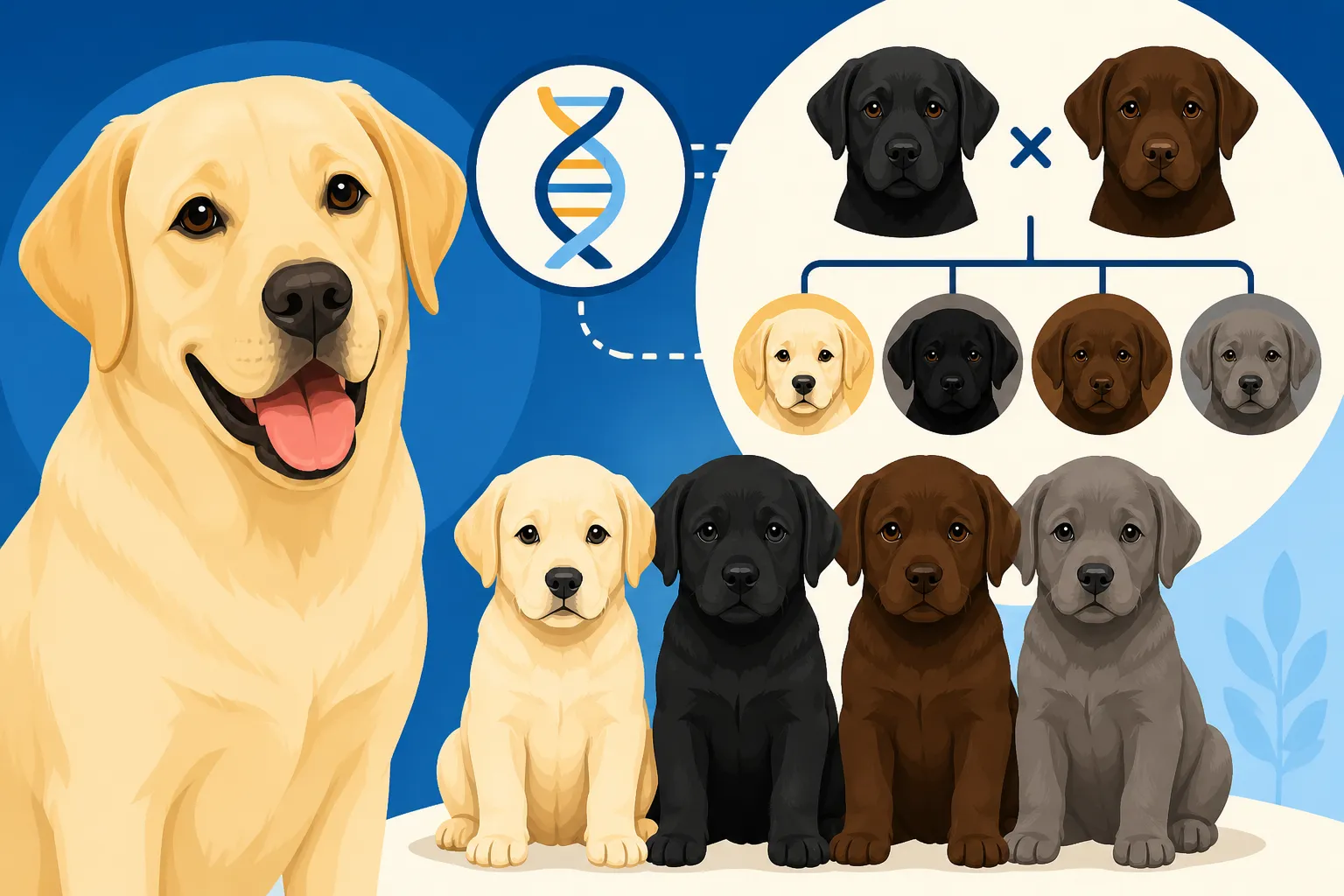
Predicting a Labrador Litter’s Colors
Many hopeful Labrador owners or breeders gaze at a pair of future parents and wonder, "What colors will the puppies be?" It’s more than just a fun guess; for breeders, understanding the genetic blueprint behind coat color is crucial for meeting breed standards and making informed decisions. This guide will unravel the fascinating genetics that determine whether a Labrador puppy will be black, yellow, chocolate, or even one of the more controversial dilute shades, helping you understand how those adorable hues are actually programmed.
The Foundation: Black, Yellow, and Chocolate
Labrador Retriever coat colors seem simple on the surface – black, yellow, and chocolate. But behind these three recognized colors lies a surprisingly intricate dance of genetics. It's not just a roll of the dice; there are specific genes at play, inherited from both parents, that dictate the final shade of each puppy in a litter. Understanding these foundational genetic principles is the first step to accurately predicting what you might see in the whelping box.
The "B" Locus: Black vs. Chocolate
At the heart of black and chocolate coloring is the "B" locus, specifically the gene that codes for eumelanin pigment – essentially, the black pigment. Dogs inherit two copies of every gene, one from each parent, influencing this trait.
If a Labrador inherits at least one dominant "B" allele, they will be capable of producing black pigment. This means their nose leather, eye rims, and paw pads will appear black. These dogs are either homozygous dominant (BB) or heterozygous (Bb), meaning they carry one dominant and one recessive gene. A black Labrador that is Bb is often referred to as a "chocolate carrier," as they carry the genetic potential for chocolate in their offspring.
For a Labrador to be chocolate, they must inherit two copies of the recessive "b" allele (bb). This genetic makeup means they can only produce brown pigment, resulting in a rich, chocolate-colored coat, a brown nose, and often lighter brown or amber eyes. This is why two black Labradors can sometimes produce chocolate puppies – if both parents are Bb carriers, they each have a chance to pass on the recessive 'b' gene. Why Chocolate Labradors Come From Narrow Lines touches on some aspects of this, highlighting how certain color lines are maintained.
The "E" Locus: Allowing Color Expression or Not
While the "B" locus determines if a dog can make black pigment or only brown, the "E" locus controls whether that pigment even shows up in the coat. This gene is responsible for producing yellow Labradors.
A dog with at least one dominant "E" allele (EE or Ee) will express the pigment determined by their "B" locus. So, if they are BB or Bb at the B locus, they'll be black. If they are bb at the B locus, they'll be chocolate. The 'E' allele acts like an "on" switch for the B locus color to be visible in the fur.
If a Labrador inherits two copies of the recessive "e" allele (ee), they cannot produce dark pigment in their fur, regardless of their "B" locus genes. This results in a yellow coat. Their nose and eye rims, however, will still show their "B" locus color (black or brown), though often faded. This is why some yellow Labs have black noses and some have brown (often called a "Dudley" nose, though technically a Dudley nose refers to unpigmented pink, which is different). This "ee" combination essentially overrides the "B" locus expression in the coat itself, effectively masking what would otherwise be a black or chocolate dog.
How the Main Colors Interact
It's the combination of these two loci that gives us the standard Labrador colors. Let's imagine we're looking at a single puppy's potential genetic makeup:
- Black Labradors: Must have at least one dominant "B" and at least one dominant "E". So, their genotype could be BBEE, BbEE, BBEe, or BbEe. They are capable of making black pigment and expressing it in their coat.
- Chocolate Labradors: Must have two recessive "b"s and at least one dominant "E". So, their genotype could be bbEE or bbEe. They are only capable of making brown pigment and express it in their coat.
- Yellow Labradors: Must have two recessive "e"s, regardless of their "B" locus genes. So, their genotype could be BBee, Bbee, or bbee. Their 'ee' genotype prevents the expression of black or brown pigment in their fur, resulting in a yellow coat.
This genetic interplay means that a breeder can often predict the possibilities for a litter based on the known genetic makeup of the parents. For example, two yellow Labradors will always produce only yellow puppies, because they both contribute an 'e' allele, making all offspring 'ee'. However, two black Labradors could produce black, chocolate, or even yellow puppies if they both carry the recessive 'b' and 'e' genes. It's truly fascinating how Black, Yellow and Chocolate in the Standard are defined by these precise genetic combinations.
Diving Deeper into Yellow Variations
While we often refer to "yellow" as a single color, anyone who has spent time around Labradors knows there's a huge spectrum within the yellow category. From nearly white to a deep, rich fox red, these variations are all genetically "yellow" but are influenced by other genetic factors that modify the intensity and shade. It's this nuanced aspect that often surprises new owners.
Why Yellow Isn't Just "Yellow"
As discussed, a yellow Labrador is genetically "ee" at the "E" locus. This means their fur contains pheomelanin, the red/yellow pigment, rather than eumelanin, the black/brown pigment. However, the amount and intensity of this pheomelanin can vary dramatically. Think of it like a dimmer switch for color. The "ee" gene simply sets the stage for yellow, but other genes, known as polygenes or modifiers, then come in to fine-tune the exact shade. These modifiers are not single, easily identifiable genes like the B or E locus, but rather a complex collection of genes that work together to create a gradient of color. This is why you see such a wide array of yellow tones, even within the same litter. How a Yellow Labrador Puppy's Shade Changes over time also speaks to these subtle, yet significant, variations.
Fox Red and White Labradors
At the deepest end of the yellow spectrum, you find the striking fox red Labradors. These dogs are genetically yellow (ee), but they have inherited a collection of those modifier genes that enhance the pheomelanin to its fullest intensity, giving them a rich, reddish-gold hue that can sometimes be mistaken for an entirely different color. They are still considered yellow by the breed standard, just a particularly vibrant shade. Fox red Labradors often carry a very strong presence of these modifier genes that boost pheomelanin production.
On the other end, nearly white Labradors are also genetically yellow. In their case, the modifier genes work to dilute or lessen the intensity of the pheomelanin, resulting in a very pale, cream, or even bleached-looking coat. Despite their light appearance, they are genetically yellow Labradors. It's important to remember that these are not separate "colors" in the way black, yellow, and chocolate are; they are variations within the yellow category. If you're looking for supplements that might enhance coat health, Chewy offers a wide range, though it won't change genetics! Whether Fox Red Is a Separate Labrador Color provides more detail on this specific hue, clarifying its status within the breed, and further emphasizes that white Labradors, for their part, are also genetically yellow.
The Role of Modifiers
These modifier genes are less understood than the main color genes, largely because they involve multiple genes acting in concert rather than a single dominant/recessive pair. Breeders who aim for a specific shade of yellow, such as fox red or a very light cream, often rely on selective breeding over generations, observing the outcomes of pairings to reinforce the desired modifier genes. It's not as simple as picking a "red" gene; it's about accumulating many small genetic influences. This makes predicting the exact shade of yellow within a litter more challenging than predicting whether a puppy will be yellow, black, or chocolate. While you can predict if a puppy will be "yellow," the precise intensity of that yellow is a more artful endeavor based on the parents' and their ancestors' shades, rather than a clear genetic calculation. It's a testament to the complexity of genetics that even within a single litter, you might see a range of yellow shades, from almost white to a deeper gold, all stemming from the same 'ee' genotype.
The Dilute Gene: Beyond the Standard Colors
Now, let's venture into territory that sparks a fair bit of debate and discussion within the Labrador community: the dilute gene. While the AKC (American Kennel Club) and other major kennel clubs recognize only black, yellow, and chocolate Labradors, certain other colors exist due to the presence of a "dilute" gene. Understanding this gene is vital for any prospective owner or breeder to be fully informed.
What the "D" Locus Controls
The "D" locus is responsible for pigment dilution. Just like with the "B" and "E" loci, dogs carry two copies of the "D" gene.
A Labrador with at least one dominant "D" allele (DD or Dd) will have full, dense pigmentation. This is the genetic makeup of all standard black, yellow, and chocolate Labradors. The 'D' allele ensures that pigment particles are tightly packed and fully expressed, leading to rich, undiluted colors.
If a Labrador inherits two copies of the recessive "d" allele (dd), all eumelanin (black/brown pigment) in their coat and skin will be diluted. This means:
- A genetically black Labrador (B_E_) that is dd becomes charcoal. The black pigment is spread out, giving a grey appearance.
- A genetically chocolate Labrador (bbE_) that is dd becomes silver. The chocolate pigment is diluted, resulting in a silvery-grey hue.
- A genetically yellow Labrador (B_ee or bbee) that is dd becomes champagne. While yellow Labradors technically only produce pheomelanin in their coat, the dilute gene still affects the eumelanin in their skin and points (nose, eye rims), resulting in a faded, often pinkish-tan nose and lighter eyes.
This dilution is a single, clear genetic trait, unlike the polygenetic modifiers that influence yellow shades. It's a "yes" or "no" for dilution.
The Controversy of Dilute Labradors
The existence of dilute Labradors – often referred to as "silver" Labradors (the most commonly known dilute color) – is a contentious topic. Major Labrador Retriever clubs around the world, including the Labrador Retriever Club of America, do not recognize these dilute colors as standard for the breed. They maintain that true Labradors come only in black, yellow, and chocolate.
The concern stems from the belief that the dilute gene was introduced to the Labrador gene pool through outcrossing, specifically with Weimaraners, at some point in the breed's history. This theory suggests that dilute-colored Labradors are not purebred and thus fall outside the established breed standard. While some dilute Labrador breeders argue that the dilute gene has always been present and simply unrecognized, official clubs largely consider it a disqualifying trait. This means a dilute Labrador cannot be shown in conformation events under these registries. What a Silver Labrador Actually Is delves deeper into the specifics of this color.
Silver, Charcoal, and Champagne Explained
Let's clarify what these dilute colors truly are in genetic terms:
- Silver Labradors: These are genetically chocolate (bb) but also carry two copies of the dilute gene (dd). Their black pigment (eumelanin) is diluted, turning the chocolate coat into a silvery-grey. Their noses and eye rims will also be diluted, appearing grey rather than brown. This is the most widely discussed dilute color.
- Charcoal Labradors: These dogs are genetically black (B_) and also carry two copies of the dilute gene (dd). The dilution turns their black coat into a dark grey, often described as charcoal. Their noses and eye rims will also be grey, rather than the solid black you'd see on a non-dilute black Lab.
- Champagne Labradors: These are genetically yellow (ee) but also carry two copies of the dilute gene (dd). While yellow Labradors technically only produce pheomelanin in their coat (which is not directly affected by the dilute gene), the dilute gene still affects the eumelanin in their skin and points (nose, eye rims). This results in a faded, often pinkish-tan nose and lighter eyes, with a very pale, creamy yellow coat.
It's important for prospective owners to be aware of the controversy and the implications for showing or breeding if they are interested in a dilute-colored Labrador. Why the Labrador Club Rejects Silver provides a good overview of the official stance. Many reputable breeders will conduct Genetic Panels Worth Running on a Labrador to ensure their breeding stock is free of the dilute gene, prioritizing adherence to the breed standard and health.
Applying Genetic Knowledge to Predict Litters
For breeders, understanding Labrador genetics is not just academic; it's a fundamental tool for responsible breeding practices. For prospective owners, it offers valuable insight into the puppies they might encounter and the decisions reputable breeders make. Predicting a litter's colors becomes a calculated exercise rather than a blind guess once you grasp the underlying principles.
Genetic Testing for Prospective Parents
The most precise way to predict a litter's colors is through genetic testing of the parent dogs. Labs can be DNA tested for their "B" locus (determining if they carry chocolate), "E" locus (determining if they carry yellow), and "D" locus (determining if they carry dilute). This provides a clear "genotype" for each parent, eliminating guesswork.
For example, a black Labrador could be:
- BBEE: Does not carry chocolate or yellow.
- BBEe: Carries yellow, but not chocolate.
- BbEE: Carries chocolate, but not yellow.
- BbEe: Carries both chocolate and yellow.
And each of these could also be DD (not dilute) or Dd (carries dilute). Armed with this information, breeders can create Punnett squares to predict the probability of each color appearing in the litter. This scientific approach helps ensure that breeders are producing healthy puppies of the desired type and avoiding unexpected traits. Using reliable DNA testing services, perhaps even through kits you can order from a place like Chewy, allows for transparency and informed decision-making. How to Check a Labrador's Dilute Status outlines the process for testing specifically for the dilute gene, providing a critical tool for conscientious breeders.
Predicting a Litter: Step-by-Step Scenarios
Let's walk through a couple of common scenarios to see how predictions work using the Punnett Square method. For simplicity, we'll assume no dilute gene (DD) is present in these examples, but remember the dilute gene (d) can also be factored in.
Scenario 1: Black Labrador (BbEe) x Chocolate Labrador (bbEe)
This pairing involves a black Labrador that carries both chocolate and yellow, and a chocolate Labrador that carries yellow.
Let's break down the gametes (what each parent can pass on):
- Parent 1 (BbEe): Can produce BE, Be, bE, be
- Parent 2 (bbEe): Can produce bE, be
Now, let's combine them in a Punnett Square:
| BE | Be | bE | be | |
|---|---|---|---|---|
| bE | BbEE | BbEe | bbEE | bbEe |
| be | BbEe | Bbee | bbEe | bbee |
From this, we can calculate the probable outcomes:
- Black (B_E_): These puppies will have at least one B and at least one E. (BbEE, BbEe) – 6 out of 8 squares, simplifying to 3/4 chance that the offspring that express eumelanin will be black.
- Chocolate (bbE_): These puppies will have two b's and at least one E. (bbEE, bbEe) – 6 out of 8 squares, simplifying to 3/4 chance that the offspring that express eumelanin will be chocolate.
- Yellow (B_ee or bbee): These puppies will have two e's, regardless of their B locus. (Bbee, bbee) – 2 out of 8 squares, or 1/4 (25%) chance.
More precisely, when considering all outcomes:
- Black Labradors (BbEE, BbEe): You'd expect about 37.5% of the litter to be black.
- Chocolate Labradors (bbEE, bbEe): You'd expect about 37.5% of the litter to be chocolate.
- Yellow Labradors (Bbee, bbee): You'd expect about 25% of the litter to be yellow (with either black or brown noses depending on the B locus).
Scenario 2: Two Yellow Labradors (BBee x bbee)
This pairing involves a yellow Labrador that doesn't carry chocolate (BBee) and a yellow Labrador that is genetically chocolate (bbee).
- Parent 1 (BBee): Can produce Be
- Parent 2 (bbee): Can produce be
| Be | |
|---|---|
| be | Bbee |
In this scenario, 100% of the puppies will be Bbee. Since all puppies will be 'ee' at the E locus, they will all be yellow. The 'Bb' at the B locus means they carry the chocolate gene, and their noses will be black. This is why two yellow Labs will only ever produce yellow puppies, but their genetic makeup still determines the color of their pigment points (nose, paw pads, eye rims). This simple scenario highlights the power of understanding genotype. The Labrador Retriever Breed Explained might shed more light on the overall genetic health considerations.
The Breeder's Ethical Responsibility
For truly responsible Labrador breeders, understanding and utilizing genetic information is paramount. It's not just about predicting colors, but also about avoiding genetic health issues and maintaining the integrity of the breed. Reputable breeders will perform comprehensive Health Clearances a Labrador Breeder Must Show on their breeding stock, which often includes genetic panels for various conditions and color genes. They will be transparent about the genetic makeup of their dogs and what colors they expect in a litter. A breeder should be able to explain the genetic probability of certain colors and be upfront about the dilute gene if it's present in their lines, even if it's not a recognized color.
This commitment to genetic health and transparency is a hallmark of a good breeder, helping ensure the long-term well-being and genetic diversity of the Labrador Lifespan and What Changes It. When you choose a puppy, particularly from a specific color lineage, the breeder's understanding of these complex genetic principles is what truly gives you peace of mind, far more than simply asking Whether AKC Papers Prove a Labrador Is Purebred. It’s about more than just aesthetics; it's about making informed decisions for the future of the puppies and the breed.
Disclaimer
This article is for general informational purposes only and does not constitute professional advice. Laws, prices and regulations vary by location and change over time. Consult a qualified professional for guidance on your specific situation.