Labrador-Proofing a Kitchen
As a Labrador owner, you know the struggle: you turn your back for one second, and suddenly your beautifully arranged kitchen counter looks like a tornado just went through it, or your dog is suspiciously quiet with a piece of trash hanging from their mouth. It's not just annoying; it can be downright dangerous for your beloved companion. This guide is all about helping you understand why your Labrador seems determined to 'help' themselves to everything in the kitchen and, more importantly, how to set up your home to keep them safe and your sanity intact.
The Insatiable Appetite: Understanding Your Labrador's Drive
Before we dive into solutions, let's get real about why Labs are such kitchen bandits. It’s not just bad manners or a lack of training; a significant part of it is hardwired into their DNA. These dogs are built to eat, and eat, and eat some more. It’s a frustrating reality for many of us who share our lives with these wonderful, food-obsessed creatures.
Why Every Crumb is a Treasure
Labradors, bless their hearts, truly do believe that every meal is potentially their last, and every stray crumb is a vital nutritional supplement. This isn't an exaggeration; studies have even shown that a substantial portion of Labradors carry a gene mutation, the POMC gene deletion, which makes them feel hungrier than other breeds, and indeed, hungrier than Labs without this particular genetic trait. It literally impacts their feeling of satiety, meaning they rarely feel truly "full." This biological predisposition can make managing their weight and keeping food secure an uphill battle.
Think about it from their perspective: they’re programmed to seek out and consume calories, an evolutionary advantage in their working dog past. In a modern home, this translates to an unwavering focus on the kitchen, where all the good stuff lives. This deep-seated drive means you can't simply ask them to ignore a plate of cookies on the counter; you have to prevent them from ever having the opportunity. It's why Why a Quarter of Labradors Overeat by Genetics delves into the science behind their constant hunger.
The sheer determination a Labrador can exhibit when food is involved is remarkable, and sometimes, a little terrifying. They can become master strategists, learning your routines, identifying weak spots in your defenses, and executing daring raids with incredible precision. They're not being malicious; they're just being Labs, following instincts that are incredibly strong.
The Power of the Labrador Nose
Beyond the genetic hunger, Labradors possess an incredible sense of smell. They were, after all, bred to retrieve fallen game, often in dense cover or across water, relying heavily on their nose to locate their prize. This phenomenal olfactory ability makes your kitchen a scent wonderland for them. That tiny droplet of spaghetti sauce on the floor, the lingering aroma of toasted bread, the faintest whiff of yesterday's roast chicken – your Labrador picks up on all of it.
Their noses are like super-powered detectors, making it nearly impossible to truly "hide" food that isn't completely sealed away. A cracker crumb under the refrigerator is a five-star meal waiting to happen. The faint scent of forgotten pizza crust in the trash isn't just a suggestion; it's a direct invitation to investigate. This means your kitchen-proofing efforts need to account for their ability to sniff out even the most minor culinary transgressions.
This potent combination of genetic hunger and an unparalleled sense of smell makes the kitchen a particularly challenging environment. It means you can't rely on "out of sight, out of mind" for very long. What's out of your sight is certainly not out of your Labrador's highly tuned sensory world. You need a multi-layered defense strategy to effectively manage this powerful drive.
Fortifying Your Food Storage
So, knowing your Labrador's inherent drive, the next step is to create physical barriers and smart habits that make the kitchen a less appealing (and less accessible) buffet. This isn't about teaching them not to want food, but rather teaching them that kitchen food is simply not available to them.
Counter-Surfing: The High-Rise Threat
Counter-surfing is a rite of passage for many Labradors and a major source of frustration (and lost meals) for their owners. Their strong hind legs and sturdy build make jumping up on counters surprisingly easy, even for relatively small Lab puppies. The key here is prevention and consistency.
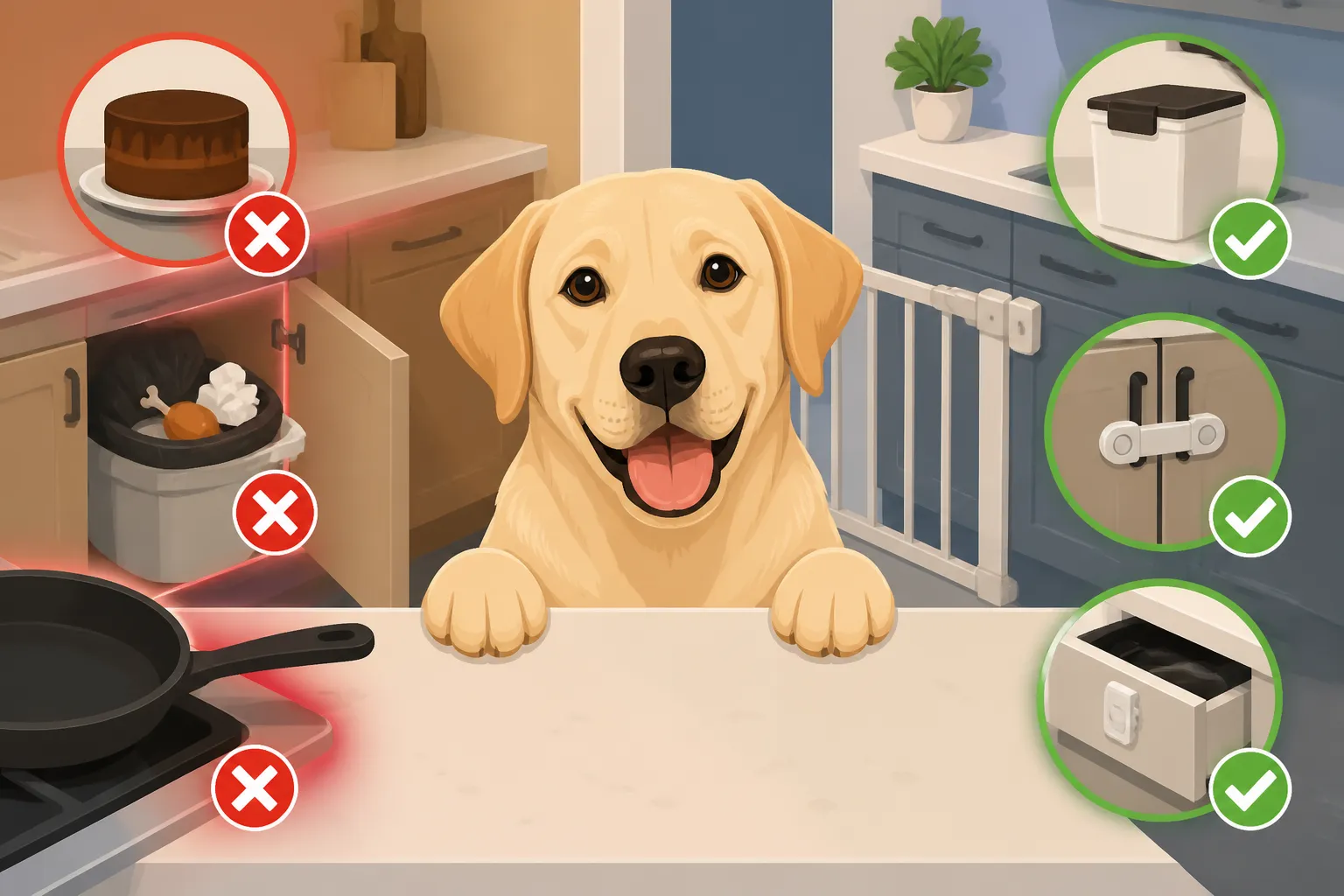
First and foremost, never, ever leave food unattended on the counters, even "just for a second." That second is all it takes for a determined Labrador to swipe an entire platter of sandwiches or a cooling cake. Get into the habit of immediately pushing anything edible to the very back of the counter, out of reach, or better yet, putting it away in a cabinet, pantry, or refrigerator. If you're actively cooking, keep your Labrador out of the kitchen or on a leash right next to you, giving them zero opportunity to practice the behavior. Don't underestimate their reach, either; a full-grown Labrador can stretch quite a distance, so what looks out of reach might not be.
Another trick is to make the counter unappealing. Some owners place noisy cookie sheets or empty plastic bottles on the edge of the counter that will clatter to the floor if nudged, creating a startling, unpleasant consequence without you having to intervene. Just make sure whatever you use won't actually hurt your dog if it falls. Ultimately, the best defense against counter-surfing is a clean, clear, food-free counter space.
Trash Can Tactics: Outsmarting the Scavenger
The kitchen trash can is a goldmine for a Labrador, full of tantalizing smells and discarded treasures. An open-top bin is practically an invitation for a feast. You absolutely need a trash can with a secure, heavy lid that latches or locks. Simply having a lid isn't enough; many Labs are adept at pawing, nudging, or even biting open lighter lids.
Look for cans designed with a locking mechanism or those that are extremely heavy and stable, making them difficult to tip over. Many pet supply stores, like Chewy or even general retailers found on Amazon, offer various styles of pet-proof trash cans that stand up to determined canines. Make sure it's not just the lid but the entire container that's secure. Some Labs will tip the whole thing over to get to the contents. If your current can isn't cutting it, consider placing it inside a cabinet with a child lock, or in a pantry, completely out of reach.
Beyond the main kitchen bin, remember smaller trash receptacles in bathrooms or offices. These are often forgotten but can contain equally dangerous items like medication wrappers, dental floss (which can cause intestinal blockages), or used tissues that might carry human germs. Just as with the kitchen, make sure all household trash is secured from curious noses and opportunistic scavengers.
Pantry and Refrigerator Defense
Your pantry and refrigerator are the ultimate food storage units, but they're only secure if the doors are actually closed and, in some cases, locked. For refrigerators, make sure the door seals properly and that your Labrador can't nose it open, a surprisingly common feat for clever Labs. If your dog is particularly persistent, consider a simple appliance lock, often used for childproofing, available from retailers on Amazon.
Inside the pantry, use sturdy, airtight containers for all food items, even those that come in seemingly dog-proof bags or boxes. Labradors are notorious for chewing through plastic, cardboard, and even thin metal containers if they smell something delicious inside. This also applies to your dog's own food! Even high-quality foods, like those from Ollie, which smell tempting to humans, need to be stored in securely sealed containers. If a bag of kibble is left open, or in a flimsy bin, it's just an unsupervised meal for your Lab. What a Labrador Costs a Month All In definitely accounts for these food costs, so don't let it go to waste – or worse, be overeaten!
For cabinet doors containing food, or even cleaning supplies, childproof latches are your best friend. There are many types, from magnetic locks that require a key to simple pressure-fit latches, all designed to keep curious paws (and sometimes noses) from prying open doors. Install these on any cabinet that houses human food, dog food, treats, or anything else you don't want your Labrador accessing.
Establishing Boundaries and Training
While physical barriers are essential, foundational training and clear boundaries are also critical components of a truly Labrador-proof kitchen. These layers of defense work together to create a safe and harmonious home environment.
Physical Barriers: Gates and Closed Doors
Sometimes, the simplest solution is the most effective: restrict access entirely. Baby gates or sturdy pet gates can be invaluable tools for creating a dog-free zone in your kitchen, especially when you're busy cooking, eating, or can't actively supervise your Labrador. There are various types of gates available at pet stores like Chewy, from pressure-mounted options for temporary use to hardware-mounted gates for more permanent barriers.
These gates are particularly useful during high-risk times, like meal preparation or dinner parties, when there's more food around and more potential for mishaps. They allow your Labrador to still be part of the household (often watching from the doorway with hopeful eyes) without being in a position to steal food or get into trouble. Consistency is key here; if the kitchen is sometimes open and sometimes closed, it sends mixed signals. Make the rule clear and stick to it, especially during the crucial puppy and adolescent phases. Labrador Puppy Socialization Windows highlights the importance of consistent rules early on.
Beyond gates, simply keeping doors closed can make a huge difference. If you have a separate dining room or pantry door, make sure it's always fully shut. Encourage family members and guests to do the same. This small habit can prevent countless opportunities for your Labrador to sneak into forbidden areas.
The Lifesaving "Leave It" Command
Teaching a solid "Leave It" command is arguably one of the most important things you can teach your Labrador, not just for kitchen safety but for their general well-being. This command means "ignore that item and look at me." It's incredibly powerful because it gives you a way to intervene and redirect your dog before they get their paws on something dangerous or forbidden.
Practice "Leave It" consistently with various distractions, starting in low-distraction environments and gradually increasing the challenge. Begin with low-value items and reward heavily when your Labrador successfully ignores them and turns to you. Build up to higher-value items and practice in the kitchen itself. If your Labrador is eyeing a dropped piece of food, a firm "Leave It" followed by a reward for compliance can save the day. This command is not just for dropped food but also for items they might find on walks, or even just preventing them from jumping on people or things. First Commands to Teach a Labrador often includes "Leave It" for good reason.
Remember, "Leave It" is a command, not a plea. Deliver it calmly and assertively, and be prepared to follow through with redirection and reward. The stronger your dog's "Leave It" is, the more confident you can be in managing unexpected kitchen temptations.
Crate Time: A Safe Zone for Everyone
For periods when you simply cannot supervise your Labrador, such as when you're out of the house, busy with guests, or even just need to take a shower, a crate can be an absolute lifesaver. A properly introduced and comfortable crate serves as a safe, den-like space for your dog, where they can relax without the temptation (or danger) of the kitchen.
Crate training should be a positive experience, never used as punishment. Introduce the crate gradually, making it a comfortable place with soft bedding, favorite toys, and occasional treats. For a food-driven Labrador, feeding meals inside the crate can help build positive associations. When you need to leave them unsupervised, you can rest assured they aren't raiding the pantry or chewing on electrical cords. This is especially useful for young puppies still learning boundaries. Crate Training a Labrador Puppy offers comprehensive advice on how to make this a positive tool for both of you.
Using a crate strategically helps prevent problems from ever occurring, which is always better than having to react to a dangerous situation. It's a proactive measure that gives you peace of mind and keeps your Labrador safe when you can't be their eyes and ears.
Identifying and Eliminating Non-Food Hazards
Kitchen-proofing isn't just about food. Many other items common in a kitchen can pose significant risks to a curious Labrador. Their tendency to investigate with their mouths means that anything within reach could become a chew toy or, worse, something ingested.
Cleaning Supplies and Toxic Chemicals
One of the most dangerous non-food hazards in any kitchen is cleaning supplies. Things like dish soap, floor cleaner, oven cleaner, drain cleaner, and even dishwasher detergent pods are highly toxic if ingested. These should never be stored in low, unlocked cabinets that a Labrador could access.
Always keep cleaning products in high cabinets, or in lower cabinets secured with childproof locks. Many of these products have appealing scents to a dog, or their packaging might look like an interesting chew toy. A simple spill on the floor could be licked up, or a bottle could be chewed through. Make it a strict rule in your home: all chemicals are stored out of reach and behind locked doors. If you're cleaning, keep your Labrador in another room until all cleaning products are put away and surfaces are dry.
| Kitchen Hazard Category | Common Examples | Labrador Risk | Proofing Solution |
|---|---|---|---|
| Food & Scraps | Counter-surfing, unsecured trash, open food containers, dropped crumbs | Obesity, choking, toxic ingestion, intestinal blockage | Clear counters, lockable/heavy trash cans, airtight containers, child locks on pantry, strict "Leave It" training. |
| Cleaning Products | Dish soap, floor cleaner, oven cleaner, detergent pods | Poisoning, chemical burns | Store in high, locked cabinets. Keep dog out of room during cleaning. |
| Small Appliances | Toasters, blenders, coffee makers, kettles | Electrical shock, burns, physical injury (if pulled down) | Keep pushed to back of counter, unplug when not in use, secure cords. |
| Medications/Supplements | Human pills, vitamins, pet meds not securely stored | Accidental overdose, poisoning | Store in high, locked cabinets. Never leave on counters. |
| Toxic Pantry Staples | Grapes/raisins, onions, garlic, chocolate, xylitol, yeast dough | Kidney failure, anemia, liver damage, bloating, poisoning | Store in high, locked cabinets or refrigerator. Use child locks. |
| Sharp Objects | Knives, skewers, broken glass (from dropped items) | Puncture wounds, internal injury | Store safely, immediately clean up spills/breaks, keep dog away during cleanup. |
| Small Objects | Magnets, twist ties, rubber bands, plastic wrap | Choking, intestinal obstruction | Keep counters clear, secure trash, don't leave loose items accessible. |
Small Appliances and Electrical Cords
The kitchen is home to numerous small appliances, each with its own set of dangers. Toasters, blenders, coffee makers, and slow cookers all have electrical cords that can be tempting for a chewing Labrador, leading to electrical shock or burns. They can also pull down heavy appliances, risking injury or burns from hot liquids.
Always push appliances to the very back of the counter when not in use, making them harder to reach or pull down. Consider unplugging them, especially if your Labrador is a known chewer. For cords that are always plugged in, like those for a refrigerator or microwave, consider cord protectors or sleeves available at hardware stores or on Amazon to prevent chewing. Ensure cords aren't dangling where a curious paw or snout can reach them.
Beyond cords, remember that hot appliances pose a burn risk. A cooling oven, a recently used stovetop, or a hot coffee maker can cause serious burns if your Labrador investigates too closely. Establish a "no-go" zone around hot cooking surfaces, and always ensure these cool down completely before allowing your dog free access to the kitchen again.
Medications and Human Supplements
It might seem obvious, but medications and human supplements are another huge no-no for Labradors. Even seemingly harmless items like ibuprofen, acetaminophen, or even some common vitamins can be toxic to dogs, sometimes fatally so. Many human medications are flavored or coated in a way that makes them appealing, and a determined Labrador can chew through child-resistant containers.
Always store all medications, human or pet-specific, in a high, locked cabinet. Never leave pill bottles on counters, nightstands, or in accessible bags. If you drop a pill, immediately pick it up and ensure your dog hasn't ingested it. Labrador medication costs can be high if they accidentally ingest something toxic, leading to emergency vet visits. Be vigilant about prescription and over-the-counter drugs, as well as any herbal supplements.
The same goes for pet medications. While designed for animals, an overdose of even a prescribed medication can be dangerous. Store your Labrador's medications just as carefully as your own, out of their reach and securely contained.
Dangerous Pantry Staples Beyond "People Food"
Finally, while we've focused on general food security, it's crucial to remember that many common pantry staples are highly toxic to dogs, even in small amounts. It's not just about guarding your dinner, but about guarding against everyday ingredients.
Here’s a quick list of some of the worst offenders to secure with extreme prejudice:
- Chocolate: Contains theobromine, toxic to dogs. Dark chocolate and baking chocolate are the most dangerous. What to Do If a Labrador Eats Chocolate is a must-read for any owner.
- Xylitol: A sugar substitute found in many sugar-free gums, candies, peanut butter, and baked goods. Even a small amount can cause a rapid drop in blood sugar and liver failure. It's incredibly dangerous. Xylitol and Other Poisons a Labrador Finds stresses the urgency of this hazard.
- Grapes and Raisins: Can cause kidney failure in dogs, even in small quantities. Their toxicity isn't dose-dependent and can affect dogs differently.
- Onions, Garlic, Chives, Leeks: All members of the Allium family, these can cause red blood cell damage and anemia. Cooked or raw, they are dangerous.
- Yeast Dough: If ingested, it can rise in the warm, moist environment of a dog's stomach, causing painful bloating and potentially alcohol poisoning as the yeast ferments.
Make sure these items are stored in sealed containers, in locked cabinets, or on high shelves that are truly inaccessible. Educate everyone in your household about these dangers, especially children who might accidentally drop something or offer a forbidden treat. Diligence in the kitchen is key to preventing accidental poisoning and keeping your beloved Labrador happy, healthy, and safe.
Disclaimer
This article is for general informational purposes only and does not constitute professional advice. Laws, prices and regulations vary by location and change over time. Consult a qualified professional for guidance on your specific situation.