The Earl of Malmesbury and Early Labradors
It’s easy to look at our beloved Labradors today and see them as a given, a constant in the world of family pets and working dogs. But the truth is, this wonderful breed, with its distinctive 'otter' tail and endlessly kind eyes, has a fascinating origin story rooted in dedicated individuals who saw something special in an emerging type of dog. This guide will take you back in time to explore the critical role played by figures like the Earl of Malmesbury in shaping the Labrador Retriever we know and adore.
The Dawn of the Labrador: Beyond Newfoundland's Shores
Before the Labrador Retriever became a defined breed in England, its ancestors were hard at work in a very different part of the world: the harsh, cold coasts of Newfoundland. These dogs were not pampered pets; they were integral members of fishing crews, working tirelessly alongside their human companions in the icy waters of the North Atlantic. Understanding their original role is key to appreciating the traits that captivated early British enthusiasts.
From St. John's to English Shores
The dogs of Newfoundland, particularly the St. John's Water Dog, were renowned for their incredible stamina, exceptional swimming ability, and an unwavering drive to retrieve. They would dive into frigid waters to pull in nets, retrieve escaped fish, and even help carry ropes between boats. Their dense, water-resistant coats and webbed feet were perfectly adapted to this demanding environment. British sailors and merchants, regularly trading with Newfoundland, began to notice these remarkable canines. They weren't just skilled workers; they possessed a quiet intelligence and biddable nature that was highly appealing.
It wasn't long before some of these St. John's dogs made the arduous journey across the Atlantic, landing on the shores of places like Poole in Dorset, England. These dogs were often brought over on fishing vessels or merchant ships, initially as companions to the sailors or as curiosities. Once on British soil, their exceptional retrieving talents quickly caught the eye of the landed gentry, who were keen on developing better dogs for their burgeoning sporting pursuits, particularly waterfowl hunting. The transition from fisherman's assistant to gentleman's gundog marked a pivotal shift in their destiny, laying the groundwork for a dedicated breeding program.
The St. John's Water Dog Legacy
The St. John's Water Dog was not a uniform breed as we understand it today; it was more of a landrace, a type of dog developed for a specific job. They varied in size and appearance but shared fundamental traits: a strong build, a thick double coat, a love for water, and that characteristic "soft mouth" crucial for retrieving game without damaging it. These dogs were the foundational stock from which the Labrador Retriever ultimately emerged. Without their unique adaptations and innate abilities, the Labrador as we know it would simply not exist. You can read more about The St. John's Water Dog Behind the Labrador.
The enduring legacy of the St. John's Water Dog is evident in every Labrador today. From their natural swimming prowess, webbed feet, and water-repellent coat to their inherent desire to carry things in their mouths gently – a trait that manifests as everything from delivering the mail to bringing you their favorite toy – these are all direct inheritances from those hardworking dogs of Newfoundland. Their genetics provided the raw material, but it took the vision and dedication of individuals in England to refine these traits into a distinct, recognizable breed.
The Malmesbury Family's Pivotal Role
Among the early British enthusiasts who recognized the immense potential of the St. John's Water Dog, the Earls of Malmesbury stand out as particularly influential. Their dedication to a specific type of dog, their careful breeding practices, and their clear vision for the breed's purpose were instrumental in the Labrador's development. This wasn't a casual hobby; it was a serious undertaking that laid the foundation for the breed's future.
The 2nd Earl of Malmesbury's Vision
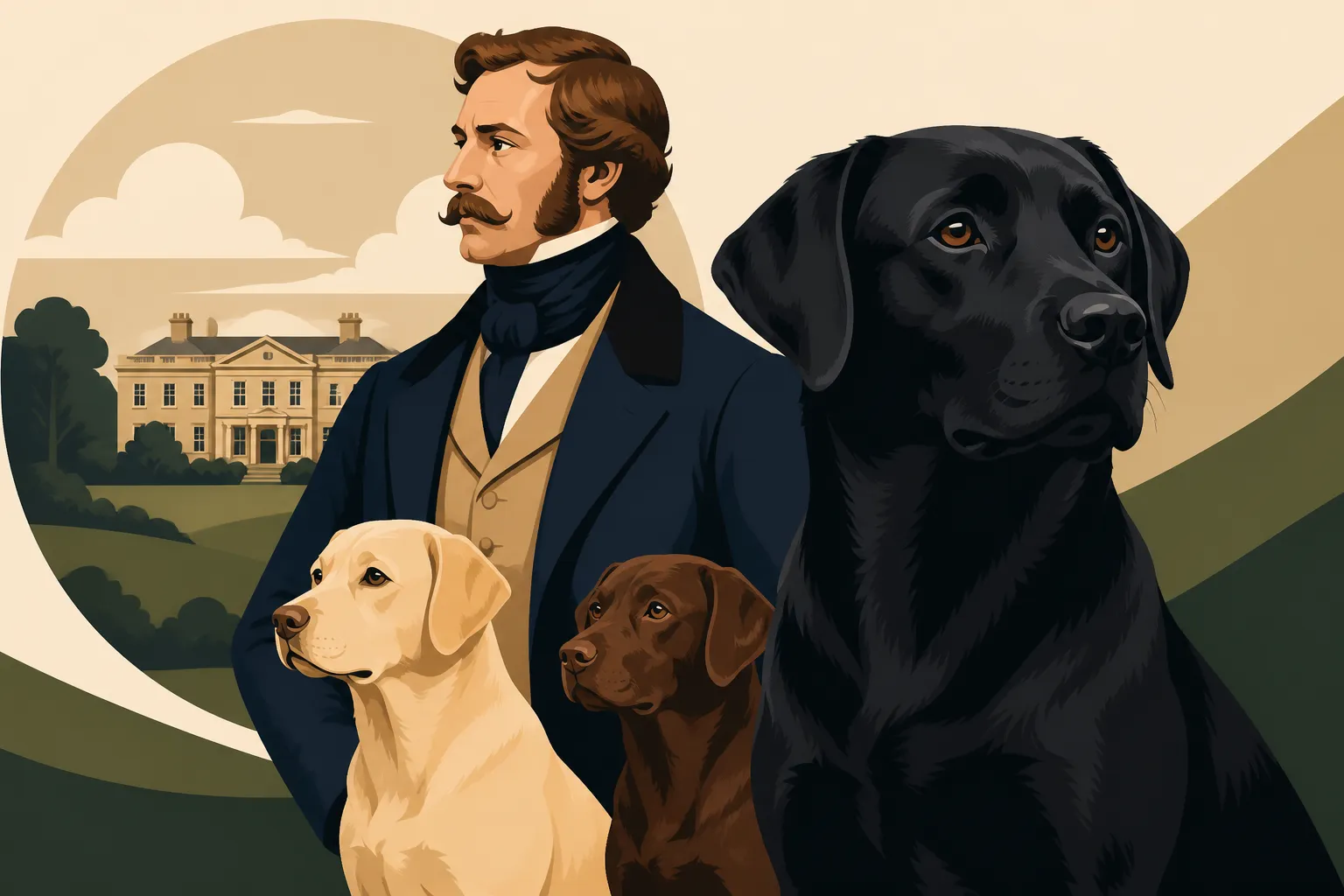
The 2nd Earl of Malmesbury, James Edward Harris, is widely credited with being one of the first to actively import St. John's Water Dogs and begin a deliberate breeding program in England in the early 19th century. He was a keen sportsman, particularly fond of wildfowling – hunting wild birds, especially ducks and geese. He quickly recognized that these Newfoundland dogs were perfectly suited for retrieving shot game from both land and water, far surpassing the abilities of other breeds then available. His estate, Heron Court in Christchurch, Dorset, became an early hub for what would eventually be known as Labradors.
The Earl's vision was clear: he wanted a dog that was robust enough to work in challenging conditions, intelligent enough to be easily trained, and possessing an exceptional retrieving instinct. He specifically sought out dogs that were primarily black in color, though yellow and chocolate coats would appear later. His breeding philosophy focused on functional excellence, ensuring that each generation retained and enhanced the working attributes that made these dogs so valuable in the field. This wasn't about aesthetics alone; it was about performance, reliability, and an unwavering partnership in the hunt.
Breeding for Function and Form
The Malmesbury kennels were not just about acquiring dogs; they were about selective breeding to solidify desired traits. The Earl and his successors understood the importance of consistency. They sought to refine the St. John's Water Dog type, emphasizing its retrieving drive, biddability, and physical attributes like the dense coat and strong swimming capabilities. While formal breed standards were still a long way off, the Malmesbury line established a clear blueprint for what a "Labrador" should be.
This meticulous approach meant carefully choosing breeding pairs, observing their offspring, and making decisions that would enhance the breed's utility. For example, they valued dogs with what we now call a "soft mouth," preventing damage to retrieved game. They also favored dogs with excellent temperaments, making them easy to handle in the field and pleasant companions at home. This focus on both function and agreeable disposition created a dog that was not only an indispensable hunting partner but also a joy to live with, a characteristic that remains a hallmark of the breed today.
Establishing the Breed's Early Reputation
The dogs from the Malmesbury kennels quickly gained a reputation among other British aristocrats and sportsmen. They were seen as superior retrievers, capable of handling the demands of large shooting estates. The 3rd Earl of Malmesbury, who inherited the passion, wrote of his dogs: "We always called our dogs Labradors, and I have until this day a distinct breed from those originally imported by my grandfather and the 5th Duke of Buccleuch." This quote is a crucial piece of historical evidence, indicating that the term "Labrador" was already in use and that specific lines were being maintained.
This early reputation was built entirely on performance. When other gentry saw the Malmesbury dogs in action, they wanted their own. This led to the spread of the Malmesbury line and its influence on other nascent Labrador breeding programs. It wasn't through advertising or public shows, but through word-of-mouth and demonstrated excellence in the field that the early Labrador established its prestige. This network of influential breeders and sportsmen shared a common goal: to cultivate the best possible gundog, a mission that secured the Labrador's place in British sporting history.
Other Early British Patrons of the Labrador
While the Malmesbury family undoubtedly played a central role, they were not alone in their efforts to establish and refine the Labrador Retriever. A number of other prominent figures, particularly in Scotland, shared a similar passion and contributed significantly to the breed's early development. Their collaborative efforts, even if informal, were vital in creating a diverse yet consistent gene pool for the emerging breed.
The Buccleuch Connection
Perhaps the most famous collaborators with the Malmesbury family were the Dukes of Buccleuch in Scotland. The 5th Duke of Buccleuch and his brother, Lord John Scott, also imported St. John's Water Dogs, particularly in the 1830s and 1840s, to their Buccleuch Estate. They were equally impressed by the dogs' intelligence, loyalty, and retrieving abilities, especially in the cold, wet conditions of the Scottish Highlands.
The Buccleuch Labradors became another cornerstone of the breed, known for their powerful build and exceptional working drive. A critical moment in Labrador history occurred when the 3rd Earl of Malmesbury gifted some of his "Labrador" dogs to the 6th Duke of Buccleuch in 1880. These dogs, coupled with the existing Buccleuch lines, formed a vital genetic link between the English and Scottish breeding efforts. This intermingling of key bloodlines helped to broaden the genetic base while maintaining the core characteristics that defined the Labrador. The Duke of Buccleuch's Labrador Kennel is a fascinating piece of history on its own, showcasing how dedicated these families were to their dogs.
Major Contributors and Kennels
Beyond Malmesbury and Buccleuch, other notable individuals contributed to the Labrador's consolidation. People like the Earl of Home and the Earl of Tankerville also maintained significant kennels and were instrumental in promoting the breed for its working capabilities. These gentlemen, with their large estates and passion for shooting, provided the ideal environment for the Labrador to prove its worth and for its qualities to be carefully observed and selectively enhanced.
These early breeders were essentially pioneers in canine genetics, long before the science was fully understood. They meticulously tracked their dogs' lineage, noting which pairings produced the most desirable traits, not unlike how a modern breeder might use DNA testing today (though without access to modern tools from, say, Chewy, to help them organize their records!). Their efforts were not isolated; they often exchanged dogs, shared knowledge, and collectively worked towards a shared ideal of the ultimate gundog. This collaborative, albeit competitive, environment was crucial for solidifying the Labrador's type and ensuring its long-term viability.
Distinguishing Early Labradors from Other Retrievers
In the 19th century, the landscape of gundogs was far more fluid than it is today. Many types of retrievers were being developed, often named after their region of origin or specific function. The Flat-Coated Retriever, Curly-Coated Retriever, and ultimately the Golden Retriever were all part of this exciting era of canine specialization. It was essential for early Labrador enthusiasts to define what made their dogs distinct and superior for their chosen purpose.
Defining Characteristics of the Malmesbury Line
The Malmesbury line, and indeed the early Labradors in general, were characterized by several key features that set them apart. Firstly, their coat: it was short, dense, and remarkably water-resistant, often described as having an oily feel. This was a direct inheritance from their St. John's Water Dog ancestors, designed to repel icy water and protect against the elements. This contrasted with the longer, often wavier coats of other retriever types.
Secondly, the "otter" tail was a distinctive identifier. Thick at the base, tapering to a point, and carried without a curl over the back, this tail acted as a rudder in the water. Coupled with powerful webbed feet, it made them unparalleled swimmers. Finally, their temperament was highly prized: a calm, biddable nature combined with an intense retrieving drive and a soft mouth. This blend of attributes made them supremely efficient and controllable in the field, a trait that the Earls of Malmesbury specifically nurtured. The combination of these features made the early Labrador an unmistakable force of nature in the hunting world.
The Evolution of Breed Standards
In the early days, there was no official "breed standard" as we understand it now. Instead, there was an informal consensus among breeders and sportsmen about what constituted an ideal Labrador. This consensus was based purely on utility and performance. If a dog excelled in retrieving, had the correct coat and tail, and possessed the desired temperament, it was considered a good example of the type.
As the 19th century progressed, the desire for formal recognition grew, spurred by the rise of dog shows and kennel clubs. The challenge was to articulate these informal criteria into a written standard that could be used for judging and breeding. This process involved a considerable amount of debate and discussion among the various breeders to ensure that the chosen standard accurately reflected the best working examples of the breed while allowing for some natural variation. This was a crucial step in transforming a working "type" into a recognized pedigree breed.
The Journey Towards Formal Recognition
The path from being a prized working dog on a few estates to a formally recognized breed was not instantaneous. It required persistent advocacy, consistent breeding, and the establishment of clear distinctions from other similar breeds. The early champions of the Labrador had to demonstrate its unique value to a broader audience of dog enthusiasts and official bodies.
Early Challenges and Acceptance
One of the initial challenges was the sheer variety of retrieving dogs being developed in Britain. Distinguishing the Labrador from its cousins, such as the Flat-Coated Retriever or the Curly-Coated Retriever, was important. While they shared a common ancestry and purpose, the Labrador's unique physical characteristics—its short, dense coat, "otter" tail, and particular head shape—needed to be consistently present and recognizable. Breeders like the Earl of Malmesbury and the Dukes of Buccleuch were instrumental in maintaining these traits through selective breeding, ensuring that their dogs conformed to a consistent "type."
Acceptance also came through performance at early field trials and informal competitions. When Labradors consistently outperformed other retrievers in tests of water work, scenting ability, and retrieving drive, their reputation solidified. These practical demonstrations proved their exceptional capabilities and garnered respect from the wider sporting dog community. Their ability to deliver a bird undamaged, even after long retrieves through dense cover or icy water, spoke volumes to those seeking the ultimate gundog.
The Kennel Club's Role in Formalization
The formal recognition of the Labrador Retriever came in 1903 when The Kennel Club in England officially recognized it as a distinct breed. This was a momentous occasion, signifying that the years of dedicated breeding by the Malmesbury family and others had paid off. Recognition by The Kennel Club meant that the breed now had an official standard, and dogs could be registered, pedigrees tracked, and titles awarded. This marked the true birth of the Labrador Retriever as a pedigree dog. You can learn more about When the Labrador Breed Was Formalized.
This formalization was not just about prestige; it provided a framework for future breeding. Breeders now had a clear standard to work towards, which helped to maintain the breed's integrity and prevent dilution of its unique traits. It also opened the door for Labradors to be exhibited in conformation shows, further increasing their public profile. This newfound status propelled the Labrador from a regional working dog to a nationally recognized and admired breed, setting the stage for its eventual global popularity.
The Lasting Impact of the Early Breeders
The dedication of pioneers like the Earl of Malmesbury continues to influence the Labrador Retriever breed to this very day. Their early efforts laid the foundational traits that breeders still strive for and that owners cherish. Without their vision and commitment, the Labrador's story would be vastly different, perhaps even non-existent.
Shaping the Modern Labrador
The traits meticulously cultivated by the Malmesbury family and other early breeders—the strong retrieving drive, the biddable temperament, the water-resistant coat, and the "otter" tail—are all hallmarks of the modern Labrador Retriever. Whether you have a show-line Labrador with its more robust build or a field-line Labrador known for its leaner athleticism, the core characteristics trace back to these foundational lines. These early decisions shaped the genetic blueprint that defines the breed's capabilities and personality.
Even the availability of modern canine nutrition and supplies, easily accessible from retailers like Chewy, helps today's owners keep their Labradors in peak condition, a luxury those early breeders could only dream of. The careful attention to health and temperament by historical breeders allowed for a resilient breed to develop, one that continues to thrive in various roles, from family companion to service dog.
Preserving the Working Heritage
Despite their widespread popularity as family pets, Labradors have never lost their working heritage. In fact, many dedicated breeders and owners continue to participate in field trials, hunt tests, and various dog sports that celebrate and preserve the breed's original purpose. This commitment to maintaining the Labrador's working abilities is a direct tribute to the original vision of breeders like the Earl of Malmesbury, who selected these dogs for their exceptional performance.
Organizations and breed clubs today work tirelessly to ensure that the Labrador's health, temperament, and working characteristics are protected for future generations. They advocate for responsible breeding practices, emphasizing health clearances and the importance of preserving the breed's functional integrity. The Labrador is a testament to what careful, purposeful breeding can achieve, and every time we see a Labrador enthusiastically retrieve a ball or bravely plunge into water, we're seeing the enduring legacy of those who first saw its potential on the shores of Newfoundland and refined it on the estates of England.
| Key Figures | Contribution to Labrador Development | Era of Influence |
|---|---|---|
| 2nd Earl of Malmesbury | Early importer and deliberate breeder of St. John's Water Dogs, establishing the "Labrador" type for wildfowling. | Early-Mid 19th Century |
| 3rd Earl of Malmesbury | Continued his family's breeding efforts, further solidifying the breed's characteristics and reputation, gifted dogs to Buccleuch. | Mid-Late 19th Century |
| 5th Duke of Buccleuch | Also imported St. John's Water Dogs to Scotland, developed a parallel working line, collaborated with Malmesbury. | Mid 19th Century |
| 6th Duke of Buccleuch | Integrated Malmesbury bloodlines with his own, further strengthening the breed's genetic foundation. | Late 19th Century |
| Lord John Scott | Brother to the 5th Duke of Buccleuch, also a key figure in establishing the Buccleuch line. | Mid 19th Century |
| Earl of Home | Another noble who maintained a prominent kennel and contributed to the breed's early spread and development. | Late 19th Century |
You might find it helpful to look into topics like Which British Estates Built the Breed to see how interconnected these early efforts were. Also, understanding The Labrador Retriever Breed Explained can offer a broader view of their journey. For those interested in the details of their ancestry, What the St. John's Water Dog Looked Like provides a glimpse into their past. The natural affinity for water, a cornerstone of the breed, is discussed in Labrador Webbed Feet and Swimming. To truly appreciate the breed's inherent nature, a dive into Labrador Temperament and Personality is essential, as these traits were carefully cultivated from the very beginning.
Disclaimer
This article is for general informational purposes only and does not constitute professional advice. Laws, prices and regulations vary by location and change over time. Consult a qualified professional for guidance on your specific situation.