Whether Show Breeding Changed the Labrador
It’s a common worry for Labrador enthusiasts, isn't it? You hear tales of the "good old days" when Labs were supposedly tougher, healthier, and perhaps a bit more rugged, leading many to wonder if the breed has truly changed over time, especially with the rise of dedicated show breeding. It’s frustrating when you love a breed and feel like its essence might be diluted. This guide will dive into the fascinating history and evolution of the Labrador Retriever, exploring how show breeding has influenced their appearance, temperament, and even health, helping you understand the modern Labrador and what to expect.
The Labrador's Original Purpose and Form
Before we talk about how Labradors might have changed, it’s crucial to understand where they came from and what they were originally built for. Their roots are deeply entrenched in functionality, a testament to their purpose.
A Legacy of Functionality
Imagine the harsh, icy waters off the coast of Newfoundland in the 1800s. This is where the ancestors of the Labrador Retriever, primarily the St. John's Water Dog, truly earned their keep. These dogs weren't pets in the modern sense; they were invaluable working partners to fishermen. Their job was tough: retrieve fish that had fallen out of nets, gather lines, and even pull small boats. This demanding environment forged a dog with incredible resilience, a thick, water-repellent double coat, webbed feet, and that famous "otter tail" for steering in the water. They needed to be strong, intelligent, and possess an unwavering drive to retrieve, even in the most challenging conditions. Their very survival depended on their ability to perform these tasks day in and day out. You can learn more about their heritage in The St. John's Water Dog Behind the Labrador.
The early Labradors brought to England in the 19th century were still very much these utilitarian animals. They were prized for their tireless work ethic and their gentle mouths, capable of carrying game without damaging it – a trait essential for both fishermen and later, gamekeepers. Their physical structure was inherently designed for efficiency in their work: sturdy bones for powerful swimming and running, a deep chest for lung capacity, and a balanced conformation that allowed for agility and endurance. There was little emphasis on pure aesthetics; form followed function entirely.
Early Standards and Working Traits
When the breed standard for the Labrador Retriever began to be formalized in the late 19th and early 20th centuries, it was largely written by people who valued the dog's working capabilities above all else. The early breeders, often aristocratic sportsmen like the Earls of Malmesbury and Dukes of Buccleuch, focused on preserving the traits that made the Labrador such an exceptional gundog. They wanted dogs that could withstand long days in the field, retrieve fallen birds from dense cover or freezing water, and remain steady and biddable at their owner's side.
These initial standards described a dog of moderate build, powerful yet agile, with a "kindly eye" and that distinctive "otter tail." The emphasis was on characteristics like a strong loin, good angulation for efficient movement, and a functional, weather-resistant coat. There was no room for exaggerated features that might hinder performance. The very definition of a "good" Labrador was intrinsically tied to its ability to perform its original duties. The breed was still quite homogeneous at this point, with breeders largely sharing the same vision for the dog, centered around its practical talents. What Labradors Were Bred to Do delves deeper into these original roles.
The Divergence of Show and Field Lines
As the Labrador Retriever gained popularity, especially after World War II, its role began to expand beyond that of a purely working dog. This broader appeal, while wonderful for the breed's recognition, also laid the groundwork for a split in breeding priorities.
What Drove the Split?
The Labrador's charm, intelligence, and adaptability meant that many families simply wanted them as companions, not just hunting partners. As interest grew, so did the desire to participate in dog shows, where physical appearance and adherence to a written standard were paramount. This shift created a fork in the road for breeders. Some remained steadfast in breeding primarily for working ability and performance in field trials, valuing drive, stamina, and instinct above all else. These became known as "field lines" or "American lines" (though they exist globally).
Others focused on perfecting the breed's appearance to excel in the conformation ring. Their goal was to produce dogs that perfectly matched the written standard, emphasizing specific head shapes, bone structure, and overall "type" that judges favored. This led to the development of "show lines," often referred to as "English lines" due to the influence of British breeding on the conformation ring. The split wasn't intentional in a malicious way; it was a natural outcome of different goals. Breeders had different ideas of what constituted the "ideal" Labrador, and those visions began to manifest in their breeding programs. The rise of large pet supply retailers like Chewy also meant that many owners might choose a Labrador without necessarily understanding the historical working context, further broadening the breed's trajectory.
Physical Differences Emerged
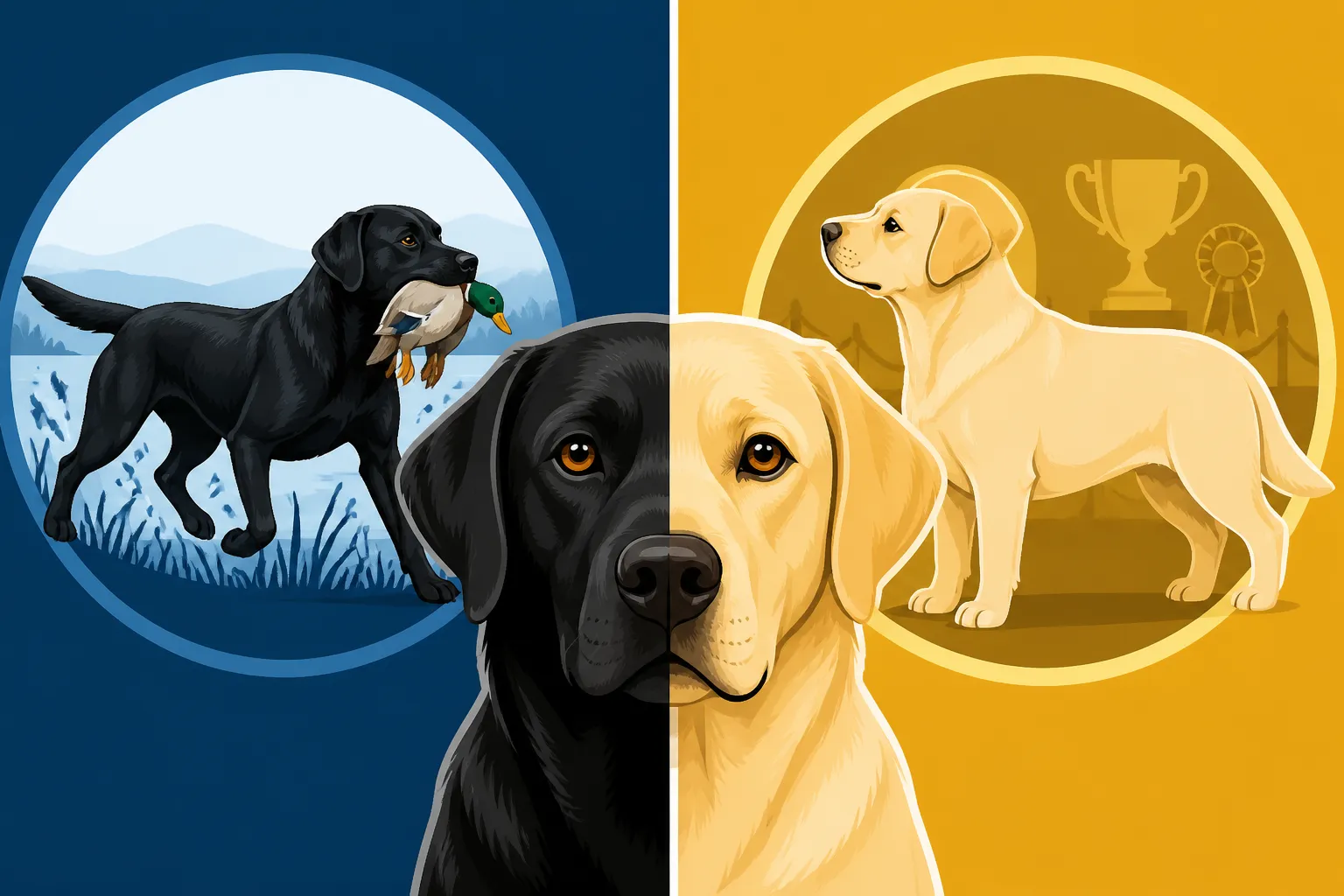
Over generations of selective breeding, distinct physical differences became noticeable between the two main types. Show line Labradors often developed a more substantial, "blockier" appearance. Their heads tend to be broader and more heavily boned, with a pronounced stop and a fuller muzzle. Their bodies are typically shorter in length, with a deeper chest and heavier bone structure overall, giving them a more compact, powerful look. This heavier build can sometimes make them appear less agile, though a well-bred show Lab should still move with purpose and grace. Their coats are often very thick and dense, sometimes even longer than what you'd see on a field dog.
Field line Labradors, conversely, are usually leaner, more athletic, and often leggier. Their heads are typically narrower, with a less pronounced stop and a finer muzzle, designed for efficient scenting and carrying. Their bodies are longer and more agile, built for speed and endurance over long distances. They tend to have lighter bone and a slightly less dense coat, again prioritizing function over the "look" of the breed standard. These differences are often what people are referring to when they talk about English and American Labrador Types. It's not that one is "better" than the other, but rather that they've been bred for different, albeit related, purposes.
Temperamental Nuances
Beyond physical appearance, some subtle but significant temperamental differences can also be observed between show and field lines. Field Labradors are bred for intense drive, boundless energy, and an unwavering focus on their retrieving tasks. They often possess a higher prey drive, are incredibly keen, and require substantial mental and physical stimulation. They thrive on having a job to do and can become bored or destructive if their energy isn't channeled appropriately. Their "go-go-go" nature is perfect for hunting or competitive dog sports.
Show line Labradors, while still possessing that classic Labrador friendliness and desire to retrieve, generally tend to be calmer and more laid-back. They are often described as having a more "off-switch" once their exercise needs are met, making them potentially easier to live with in a family setting for those who aren't seeking a dedicated working dog. Their trainability is still excellent, but their overall intensity is typically lower than their field-bred counterparts. This doesn't mean they are lazy or lack the Labrador spirit; it simply means their drive is often expressed differently and might not require the same level of demanding exercise to keep them content. The question of Whether English Labradors Are Calmer is a common one precisely because of these perceived differences.
| Trait | Typical Show (English) Labrador | Typical Field (American) Labrador |
|---|---|---|
| Build | Blockier, stockier, heavier bone | Leaner, leggier, more athletic |
| Head | Broader, squarer, more pronounced stop | Narrower, finer muzzle, less stop |
| Coat | Very dense, often thicker | Slightly less dense, more streamlined |
| Energy Level | Generally calmer, more "off-switch" | High drive, boundless energy, intense |
| Tail | Often thicker at base, "otter-like" | Can be thinner, carried gayer |
| Purpose | Conformation showing, family companion | Hunting, field trials, dog sports |
Evaluating the Impact of Show Breeding on Health and Temperament
The divergence in breeding goals naturally raises questions about the impact on the overall health and temperament of the breed. Have these selective pressures inadvertently introduced new challenges or exacerbated existing ones?
Health Implications of Conformation
One of the most significant concerns when discussing changes due to show breeding revolves around health. When breeders prioritize aesthetic traits, there's always a risk that structural elements crucial for a dog's long-term health might be overlooked or even inadvertently compromised. For Labradors, this often comes up in discussions about joint health. While Labrador Hip and Elbow Dysplasia are multi-factorial genetic conditions that affect both lines, some argue that the emphasis on a specific "blocky" build and heavy bone in show lines could potentially put more stress on joints, or that an overly steep angulation, while visually appealing, might not be the most biomechanically sound for a dog built to move efficiently.
Conversely, a more compact body type might also lead to a deeper chest, which, while aesthetically pleasing to some, could be a factor in conditions like bloat, though this is also seen across all lines. Reputable show breeders are acutely aware of these potential pitfalls and conduct extensive health clearances, like OFA and PennHIP, on their breeding stock. They strive to balance conformation with sound structure and genetic health, understanding that a beautiful dog isn't truly beautiful if it can't live a long, comfortable life. You'll find many breeders listing their health certifications on their websites, or even offering advice on good quality food from places like Chewy that supports joint health.
Temperament and the Show Ring
Another area of debate concerns temperament. Critics sometimes suggest that show breeding has led to Labradors that are "softer" or less driven than their working ancestors. While it's true that the intense, relentless drive of a field-bred Labrador might not be necessary (or even desirable) for a dog whose primary role is a family companion and show ring participant, a well-bred Labrador, regardless of line, should still possess the core traits of the breed: intelligence, biddability, an eager-to-please nature, and a strong retrieving instinct.
The argument isn't that show Labs lack temperament, but that the intensity of certain traits might have shifted. A show Labrador might be perfectly content with a couple of brisk walks and some fetch in the yard, whereas a field Labrador might genuinely need hours of active work or training to prevent boredom-induced mischief. However, it's a huge disservice to assume all show Labs are inherently docile or lack drive. Many excel in obedience, agility, and even some scent work, proving their inherent Labrador intelligence and desire to work alongside their humans. Understanding Labrador Temperament and Personality involves recognizing this spectrum of expression.
Preserving the Core Labrador
Despite the differences, responsible breeders across both show and field lines share a common goal: to preserve the best qualities of the Labrador Retriever. This means maintaining their wonderful temperament, their health, and their innate retrieving desire. For show breeders, this involves selecting dogs that not only meet the physical standard but also possess the characteristic Labrador friendliness, intelligence, and willingness to please. They are guardians of the breed's "look" as defined by the standard, but also its soul.
Many breeders understand that even a show dog needs to be a functional, healthy animal. They focus on structural soundness, correct movement, and ensuring that the physical traits don't compromise the dog's ability to live a full, active life. Similarly, many field breeders now acknowledge the importance of a good temperament and sound health alongside intense working ability. The most ethical breeders, regardless of their focus, are essentially working to maintain the integrity of the breed as a whole, ensuring that whether your Labrador comes from a show line or a field line, they are still unmistakably a Labrador Retriever at heart.
The Modern Labrador: A Spectrum of Traits
When we talk about whether show breeding "changed" the Labrador, it's really about understanding that the breed now exists along a spectrum, offering a wonderful variety to prospective owners.
Beyond Black and White: Understanding the Nuances
It's too simplistic to say that show breeding definitively "changed" the Labrador in a negative way, or that field Labradors are the only "true" Labradors. What has happened is that selective breeding for different purposes has led to a diversification within the breed. The qualities that make a dog excel in the show ring (conformation, poise, specific aesthetics) are different from those that make a dog a champion field trial performer (explosive speed, boundless stamina, acute scenting ability).
Many Labradors today actually fall somewhere in the middle, embodying a blend of traits. Breeders focused on versatility might aim for dogs that can perform well in both realms, or simply be excellent family companions with enough drive for everyday activities. The key is to recognize that the modern Labrador isn't a single, uniform type, but a rich tapestry of individuals, each carrying elements of their shared heritage. If you're wondering how much the breed has really shifted, reading How the Labrador Changed in Fifty Years can offer some historical perspective.
Choosing the Right Labrador for Your Home
Given this spectrum, the real question for a prospective owner isn't "has the Labrador changed?" but "which kind of Labrador is right for me?". If you're an avid hunter, plan to compete in field trials, or lead a highly active outdoor lifestyle, a field-bred Labrador with its intense drive and lean build might be your perfect match. You'll need to be prepared for their high energy and need for consistent, engaging work. They thrive on having a job.
If, on the other hand, you're looking for a devoted family companion who enjoys walks, games of fetch, and snuggling on the couch, a well-bred show line Labrador might be a better fit. They still require exercise and training, but their overall intensity is often more manageable for typical family life. They still love to retrieve and will happily accompany you to the park. The best approach is to research breeders, meet the parent dogs, and understand the lineage and typical temperaments of their puppies. Don't just pick a puppy based on looks; consider the parents' energy levels, biddability, and what their breeder aims to produce. A good breeder, no matter their focus, will be transparent about their dogs' traits and help you find a puppy whose personality and potential energy levels align with your lifestyle. Websites like Chewy, while not breeders, often have extensive resources on breed characteristics and what to look for when choosing a puppy, including discussions on different Labrador types, as discussed in Choosing Between an English and American Labrador.
Disclaimer
This article is for general informational purposes only and does not constitute professional advice. Laws, prices and regulations vary by location and change over time. Consult a qualified professional for guidance on your specific situation.