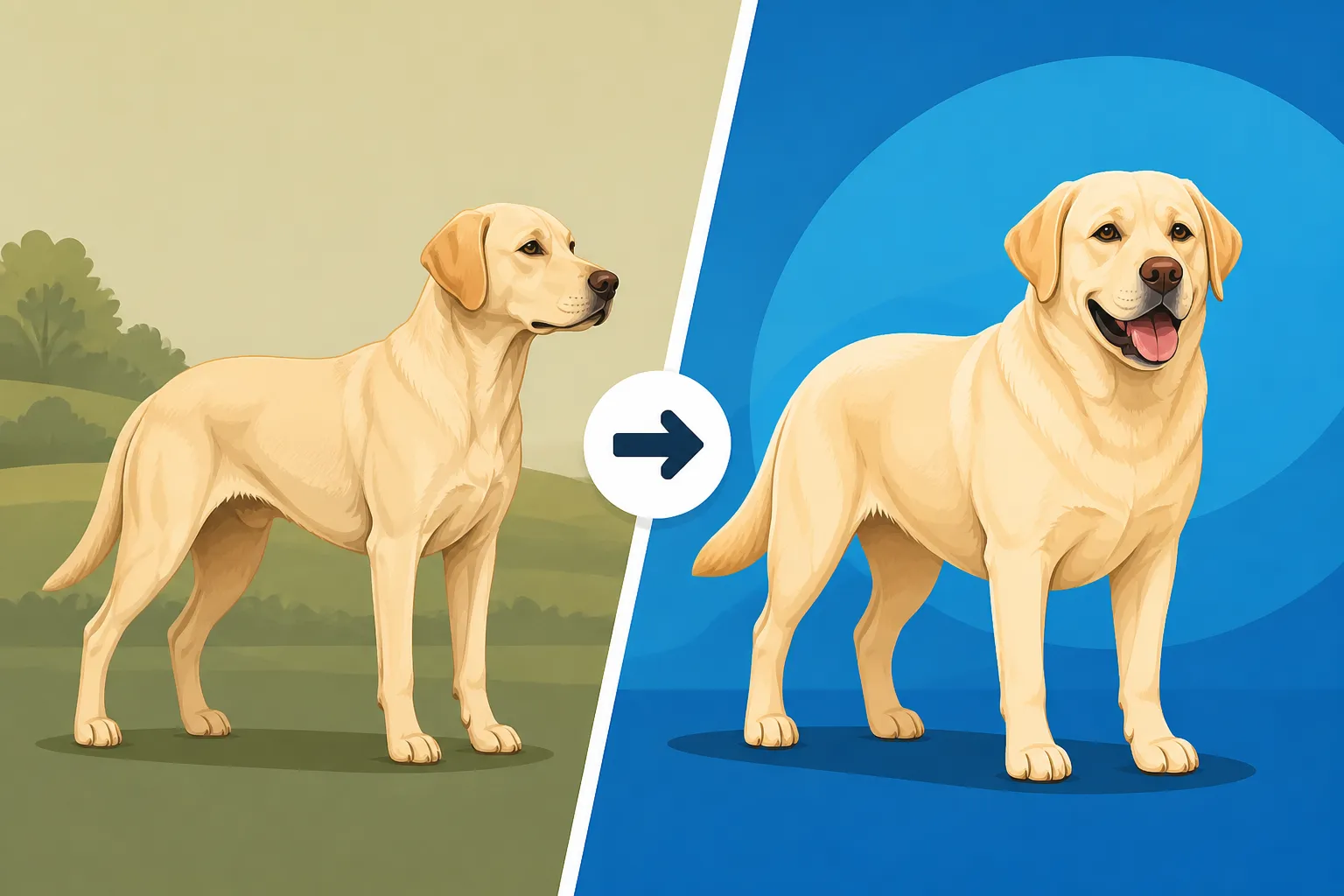
How the Labrador Changed in Fifty Years
It’s a question I hear so often from seasoned Labrador lovers, and it really hits home: "Is it just me, or do Labradors look and act differently than they did, say, fifty years ago?" If you’ve felt this way, you’re not imagining things. Our beloved Labradradors, while still retaining that unmistakable charm and zest for life, have absolutely seen some shifts over the decades. This guide dives deep into the subtle yet significant transformations that have shaped the Labrador Retriever into the dog we know today, from their physical appearance to their bustling personalities and even their health profiles.
The Shifting Silhouette: Changes in Labrador Conformation
Fifty years ago, the lines between a "show Labrador" and a "field Labrador" weren't nearly as pronounced as they are now. Labradors were, at their heart, versatile working dogs, equally capable of retrieving ducks in the marshes and looking handsome in the ring. They were bred for function first, with form following that purpose. However, as the breed gained immense popularity, different breeding goals began to influence their physical development, leading to some noticeable changes in their build and overall appearance.
The Divergence of Show and Field Lines
The most striking change in Labrador conformation over the last half-century is undoubtedly the significant divergence between what are commonly referred to as "English" (or show) lines and "American" (or field) lines. Back in the day, a dog could easily excel in both realms. Breeders strived for a dog that was robust enough for a day's work, agile enough to move through tough terrain, and yet possessed the dignified presence required for the show ring. The ideal was a balanced dog.
Over time, as competitive dog shows became more specialized and field trials demanded increasingly specific athletic traits, breeders began to select for different characteristics. Show breeders focused on exaggerated "breed type" as defined by the standard, often leading to a heavier, more substantial dog. Field breeders, conversely, prioritized speed, endurance, and intense retrieving drive, resulting in a lighter, more athletic build. This means that a Field Line Labrador Traits today might look quite different from an Show Line Labrador Traits, even though they are both purebred Labradors.
Exaggerated Features and Breed Standards
When you look at photos of Labradors from the 1970s and compare them to some of today’s show champions, you might notice that certain features have become more pronounced. For instance, the "blocky" head, often described as part of the desired "otter tail" appearance, can sometimes appear more exaggerated in modern show lines. These dogs often have heavier bone structure, broader chests, and a more compact body.
Conversely, some field lines have become much leaner, almost rangy, with narrower heads and finer bone structure. These changes, while still technically within the broad parameters of the breed standard, represent a shift in emphasis. The breed standard is a written description, but its interpretation evolves, and breeders select for what they believe best embodies that ideal, often leaning towards more extreme versions of desired traits. This has contributed to English and American Labrador Types becoming quite distinct in appearance.
More Than Just Looks: Evolving Labrador Temperament and Drive
Physical changes aren't the only transformation. The very essence of the Labrador, its famous temperament, has also seen shifts. While still known for being friendly, outgoing, and generally good-natured, the intensity and focus of their drive have become more varied, reflecting the diverse purposes for which they are now bred.
Energy Levels and Drive
Many long-time Labrador owners recall a time when all Labs were bundles of energy, but specifically, purposeful energy. They were bred to work tirelessly, often for hours on end, retrieving game. This intense, focused drive was channeled into their work. Today, while many Labradors still possess significant energy, its manifestation can vary greatly.
Some modern pet lines have been selectively bred for a calmer, more sedentary household companion, leading to dogs that might be content with moderate exercise. However, other lines, particularly those from strong working or field backgrounds, might exhibit an incredibly high, almost frantic energy level that can be challenging for an average family to manage. This broader spectrum of energy means that understanding Labrador Energy Level by Age and specific lineage is more crucial than ever for prospective owners. The frustration of an owner with a "hyper" Labrador stems often from mismatched expectations, not necessarily a "bad" dog.
Trainability and Adaptability
Labradors have long enjoyed a reputation as one of the most trainable breeds, often topping intelligence lists. This perception largely stems from their eager-to-please nature and high food drive, which makes them incredibly responsive to positive reinforcement. Fifty years ago, this trainability was almost universally channeled into practical tasks: hunting, retrieving, or farm work. Their biddability was inherent to their utility.
In the modern era, while Labs are still highly trainable, the type of training and the distractions they face have changed. A Labrador bred for a relaxed family environment might not have the same intense focus or inherent drive for complex tasks as one from a dedicated working line. Furthermore, the pervasive The POMC Gene and Labrador Appetite, which causes many Labradors to be exceptionally food-driven, can be a double-edged sword. It aids in training but also contributes to issues like counter-surfing and resource guarding if not managed properly. This means the approach to Training a Labrador From Puppy to Adult needs to be nuanced, recognizing the specific genetic predispositions and energy levels of the individual dog.
A Look at Labrador Health Trends Over Five Decades
Health is another area where significant changes have occurred, both in our understanding of breed-specific conditions and in the prevalence of certain issues. Fifty years ago, veterinary medicine was less advanced, and genetic screening for hereditary diseases was far from the norm. Today, responsible breeders have a wealth of tools at their disposal, but new challenges have also emerged or become more recognized.
Genetic Health Screening Becoming Standard
Back in the day, discovering a genetic health issue like hip or elbow dysplasia in a Labrador was often a matter of noticing symptoms as the dog aged. Breeders might have culled affected individuals or removed them from breeding programs based on observed issues, but systematic screening was rare. Over the last five decades, organizations like the Orthopedic Foundation for Animals (OFA) and the PennHIP program have revolutionized canine health.
These advancements mean that reputable breeders now routinely screen their breeding stock for conditions like Labrador Hip and Elbow Dysplasia. We also have genetic tests for eye conditions such as Progressive Retinal Atrophy in Labradors and neurological conditions like Exercise-Induced Collapse in Labrador Retrievers. While these tests don't eradicate the issues entirely, they provide breeders with the information needed to make informed decisions, ideally reducing the incidence of these debilitating diseases in future generations. This increased awareness means that while these conditions still exist, we have a far better chance of preventing them than fifty years ago.
Emerging and Persistent Health Concerns
Despite the strides in genetic screening, Labradors still face a range of health challenges, and some might even appear more prevalent now. Obesity, for instance, has become a significant concern. While Labradors have always been food-lovers, the modern sedentary lifestyle combined with their genetic predisposition (like the POMC deletion) makes them particularly prone to weight gain. This is why understanding Why Labradors Gain Weight So Easily is critical for current owners.
Furthermore, cancer rates, particularly certain types like lymphosarcoma, hemangiosarcoma, and mast cell tumors, are often cited as a concern in the breed, though whether this represents a true increase or simply better detection is debatable. Allergies, both environmental and food-related, also seem to be a common complaint among Labrador owners today. These conditions, combined with advancements in veterinary care, mean that while Labs might live longer on average due to better treatment options, the Labrador Lifespan and What Changes It is still influenced by these persistent health challenges.
| Characteristic | Circa 1970s Labrador (General Type) | Modern Show Line Labrador | Modern Field Line Labrador |
|---|---|---|---|
| Primary Focus | Versatile working dog, family companion | Conformation excellence, adherence to specific standard | High-performance gundog, agility, speed |
| Build/Conformation | Moderate, athletic, balanced | Heavier bone, broader head, shorter muzzle, more compact | Lighter bone, finer head, longer muzzle, more rangy |
| Energy Level | High, but generally focused and biddable | Moderate to high, can be calmer indoors if exercised | Very high, intense, requires significant mental/physical output |
| Coat | Dense, water-resistant double coat | Very dense, often heavier undercoat | Dense, slightly less bulky, still highly protective |
| Temperament | Eager to please, loyal, strong retrieving drive | Calm, amiable, good family pet, retains retrieving drive | Intense, highly driven, tenacious, strong prey drive |
| Health Screening | Limited to observation, general vet checks | Extensive genetic screening for hips, elbows, eyes, etc. | Extensive genetic screening for hips, elbows, eyes, etc. |
Breeding Philosophies and the Modern Labrador Owner
The popularity explosion of the Labrador Retriever has had profound effects on breeding philosophies. What was once a more niche working breed is now one of the most beloved family dogs globally. This widespread appeal has diversified the reasons people seek out Labradors, and consequently, influenced how they are bred.
The Rise of the "Pet Labrador" Market
Fifty years ago, if you wanted a Labrador, you likely sought out a breeder whose dogs either worked in the field or consistently performed well in the show ring, demonstrating both type and temperament. The expectation was that these dogs were robust, intelligent, and capable. As Labradors became increasingly popular as family pets, a "pet market" emerged, sometimes distinct from the traditional working or show circles.
This shift meant that some breeders began to prioritize traits desirable in a pet, such as a very calm disposition or a specific color, sometimes at the expense of rigorous health testing or preserving working drive. While many dedicated breeders still uphold the highest standards for health, temperament, and conformation, the sheer demand for Labradors has regrettably led to less scrupulous breeding practices in some instances. This is why Finding a Reputable Labrador Breeder is more critical than ever; you need to know their breeding philosophy and what traits they prioritize.
The Importance of Research for Prospective Owners
Given these significant changes over the past five decades, the term "Labrador Retriever" today encompasses a wider range of physical types and temperaments than it once did. For a prospective owner, this means that simply wanting "a Labrador" isn't enough. You really need to dig in and understand what kind of Labrador will best fit your lifestyle.
Do you have an active family, ready for daily long walks, swimming, and mental challenges? A field-bred Labrador might be a good fit, but be prepared for intense drive. Do you prefer a calmer companion for gentle strolls and cozy evenings? A well-bred show line dog might be more suitable. It's vital to research lines, ask breeders about their specific goals, and understand the difference between a high-energy working dog and a more laid-back family companion. Stores like Chewy offer a vast array of enrichment toys and durable gear that can help channel a Labrador's energy, no matter their specific drive, but the foundational match comes from careful breeder selection. The future of the Labrador, and indeed What the Labrador's Future Looks Like, relies on informed owners making responsible choices.
Disclaimer
This article is for general informational purposes only and does not constitute professional advice. Laws, prices and regulations vary by location and change over time. Consult a qualified professional for guidance on your specific situation.