Whether High Value Treats Backfire on a Labrador
One of the most common dilemmas we face as Labrador owners, especially when we're deep into training, is finding that perfect balance with treats. You want your loyal companion to be motivated, excited to learn, and responsive to your commands. So, naturally, you reach for the good stuff – those irresistible, high-value treats. But a nagging worry starts: are these amazing rewards actually going to backfire, making your Labrador a spoiled diva who only works for prime steak? This guide is here to unravel that very common concern, helping you understand how to harness the power of high-value treats without creating a picky, unmotivated pup.
Understanding "High-Value" for a Labrador
Let's be real, a Labrador Retriever's food drive is legendary. It's one of their most endearing (and sometimes challenging) traits. This deep-seated love for all things edible is a powerful tool in training, but like any powerful tool, it needs to be understood and wielded with care. When we talk about "high-value" treats, we're not just talking about something tasty; we're talking about something that truly resonates with your particular Labrador's deepest desires.
What Makes a Treat "High-Value" to a Lab?
For a Labrador, a high-value treat isn't just about nutrition; it's a sensory experience. It typically involves smell, texture, and often, novelty. Think about it: a piece of dry, everyday kibble might be fine for dinner, but it’s rarely going to motivate a Labrador to perform a perfect stay in a park full of squirrels. A high-value treat, on the other hand, makes their eyes light up, their tail wag furiously, and their focus sharpen like a laser beam.
The hierarchy usually goes something like this: dry kibble is at the bottom, followed by commercially available chewy training treats (like those little soft squares), then human-grade moist and smelly treats. Imagine a tiny piece of cheddar cheese, a sliver of cooked chicken, or a bit of hot dog. These are the "jackpot" rewards that instantly capture your Labrador's attention. Even better, some Labradors go absolutely wild for specific smells, like salmon or liver, so it's worth experimenting to find your dog's personal gold standard. The stronger the smell, the softer the texture (making it quick to chew and swallow), and the rarer it is, the higher its value. These are the kind of treats that truly motivate, especially for a breed known for its immense food drive. For more ideas on what gets their tails wagging, check out Treats That Motivate a Food-Driven Labrador.
The Psychology Behind High-Value Reinforcement
Training a dog, especially a bright and eager Labrador, relies heavily on the principles of positive reinforcement. This isn't about bribing; it's about teaching your dog that performing a certain behavior leads to a desirable outcome. When you use a high-value treat, you're creating a super-strong, positive association between the action (e.g., coming when called) and the reward (that delicious, rare morsel). It's essentially saying, "Yes! That's exactly what I wanted, and here's something amazing to prove it!"
Think of it from your Labrador's perspective. If you're learning a new, complex skill at work, a simple "good job" might be nice, but a bonus check or a public commendation makes you far more likely to remember and repeat that effort. High-value treats serve as that "bonus check" for your dog. They make the learned behavior stick faster and more reliably, especially in challenging environments where there are many distractions competing for your Labrador's attention. This isn't about your dog only working for the treat; it's about strengthening the neural pathways that connect the command to the desired action and the immense satisfaction of the reward. It makes the behavior feel incredibly worthwhile, laying a strong foundation for future reliability.
The Potential "Backfire" Scenarios
It's completely valid to worry that consistently using the "good stuff" might spoil your Labrador. We've all heard stories, or perhaps experienced it ourselves, where a dog becomes a bit of a connoisseur, turning their nose up at anything less than gourmet. This isn't just a hypothetical concern; there are very real ways that high-value treats, if not managed correctly, can complicate your training journey.
The "Only Works for the Good Stuff" Dilemma
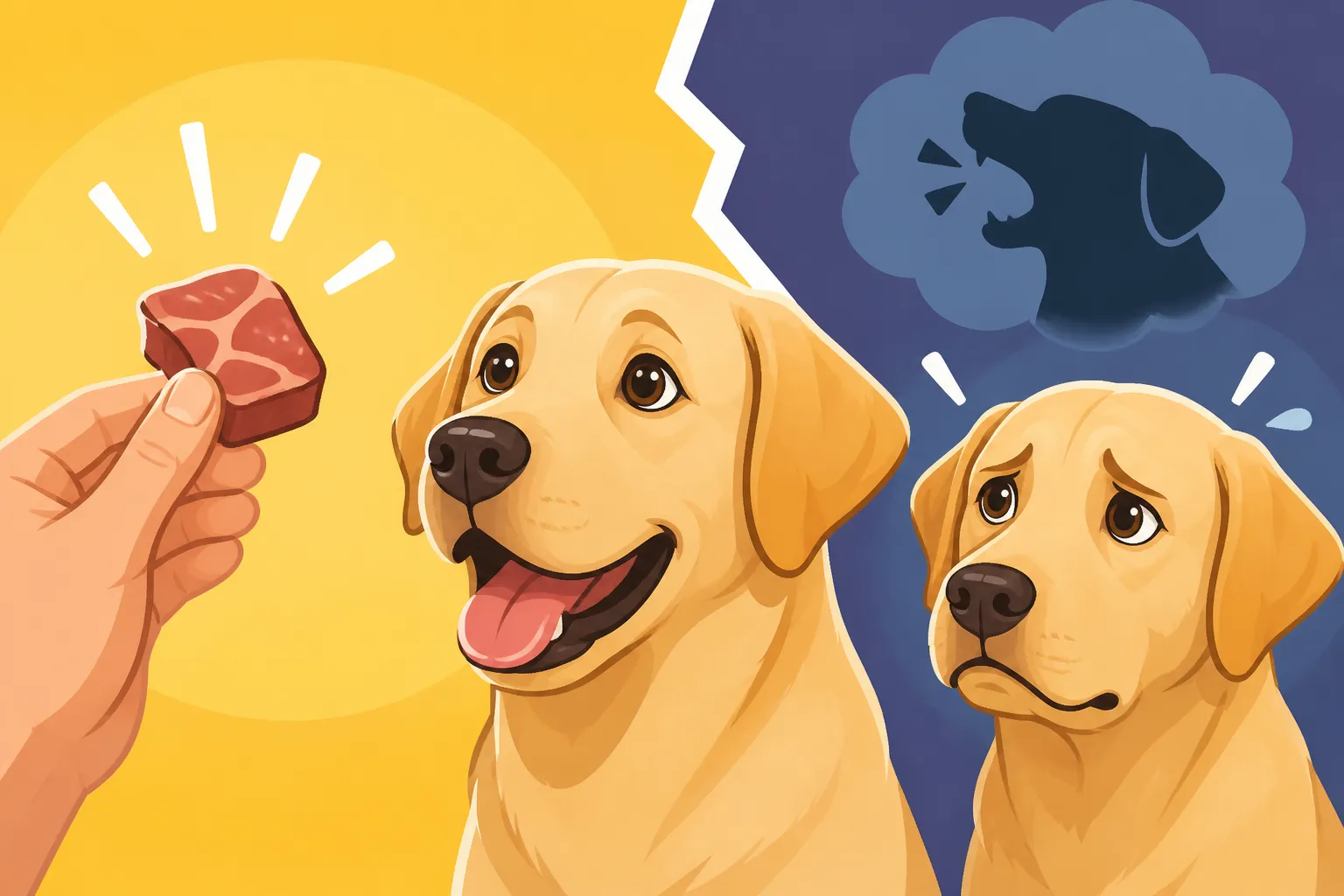
This is perhaps the most common fear: you start off strong, using delectable chicken bits to teach a bomb-proof recall in the backyard. It works wonders! But then you venture to the dog park, armed with those perfectly acceptable, commercially available training treats, and suddenly your Labrador seems to have forgotten their name. They sniff the treat disdainfully and go back to exploring, seemingly holding out for the "real" good stuff.
This scenario is frustrating because your Labrador has learned to discriminate between rewards. They understand that while a pat on the head or a basic biscuit is okay, there's a higher tier of reward available. If you always use high-value treats for every single repetition, especially in easy, low-distraction environments, your dog might come to expect that level of reward for all tasks. When you then offer a lower-value treat, their motivation plummets. It's like working for minimum wage after getting used to a six-figure salary; the incentive just isn't there. This can make training inconsistent, with your Labrador performing brilliantly when you have the special treats, but failing when you don't. This can be especially true for a breed like the Labrador, known for their strong drive for What the POMC Deletion Does to Appetite.
Dependence on External Rewards
Another concern is that your Labrador might become entirely dependent on seeing or sniffing a treat before performing a command. The goal of training isn't just for your dog to do what you ask when a treat is visible; it's for them to perform reliably because they understand the command and trust you. If your Labrador only offers a "sit" when they see a piece of cheese in your hand, then they aren't truly learning the command itself as much as they are learning to "perform a trick for food."
This reliance on an obvious external reward can hinder the generalization of behaviors. A perfectly trained "stay" in your quiet living room might fall apart the moment you ask for it at a bustling outdoor cafe if your Labrador isn't confident they'll get that high-value reward. The ultimate aim is for your dog to respond to your verbal cues or hand signals, even without the immediate visual prompt of a treat. We want our Labradors to perform because they've learned the meaning of the command and associate good things with it, not because they're being constantly lured or bribed. This is especially important as they grow into adolescence, when their brains might seem to temporarily forget everything they've learned.
Weight Gain and Dietary Concerns
Let's face it: Labradors are famously enthusiastic eaters. This wonderful trait can quickly turn into a problem when high-value treats are introduced without careful consideration. Most high-value treats – cheese, hot dogs, cooked meats – are also high in calories and often fat. A few pieces here and there won't hurt, but if you're using them extensively throughout the day for training, those calories add up alarmingly fast.
Given that Labradors are already prone to Why Labradors Gain Weight So Easily, overfeeding treats, even small ones, can quickly lead to an overweight dog. Obesity in Labradors is a serious health risk, contributing to joint problems, heart disease, and a significantly How Much Longer a Lean Labrador Lives. It's a cruel irony that the very thing you use to make your dog healthier (through training) could inadvertently make them less healthy if not managed. This is a practical, immediate backfire that many owners experience, and it's why monitoring your Labrador's overall caloric intake is crucial.
Strategies to Prevent High-Value Treat Backfire
The good news is that you don't have to abandon high-value treats altogether. They are incredibly effective tools when used thoughtfully. The key lies in strategic deployment and a gradual transition plan, ensuring your Labrador remains motivated without becoming dependent or gaining unnecessary weight.
Strategic Use: When to Deploy the Big Guns
High-value treats are best reserved for specific, high-impact scenarios. Think of them as your training "superpower" – you wouldn't use superpowers for everyday tasks when regular strength will do. Here are the prime times to deploy those irresistible morsels:
- Initial Learning: When your Labrador is first learning a new, complex command, especially something critical like a reliable recall or a nuanced behavior like a calm "leave it." The intense motivation from a high-value treat helps solidify the connection between the action and the reward much faster.
- High-Distraction Environments: When you're trying to proof a behavior in a challenging new location, such as a busy park, a noisy street, or near other dogs. The high value helps your Labrador focus on you despite the overwhelming external stimuli. For example, building a strong Labrador Recall and Working Off Leash often requires those super special rewards initially.
- Overcoming Fear or Aversion: If your Labrador is hesitant about a new experience (like getting in the car, meeting a new person, or tolerating nail trims), high-value treats can create positive associations and help them overcome their apprehension.
- "Jackpot" Rewards: Occasionally, for an exceptionally good or difficult performance, deliver a "jackpot" – a handful of high-value treats, or a continuous stream of treats for a few seconds. This marks an outstanding effort and really reinforces stellar behavior.
Using high-value treats sparingly and intentionally for these moments ensures they retain their power and excitement for your Labrador, rather than becoming the expected norm. Resources like BAXTER & Bella, which offer structured online training programs, often guide owners on when and how to best utilize different reward types for maximum effect without creating dependency. They teach you to think strategically about your dog's motivation.
Fading the Lure and Varying Rewards
The art of smart treat usage lies in fading them out effectively once a behavior is understood. You don't want your Labrador to always expect a five-star meal for every "sit." The process of "fading" means gradually reducing the predictability and value of the treat.
Once your Labrador reliably performs a new command in a low-distraction environment, start introducing variability. Don't offer a high-value treat every single time. Sometimes, give a lower-value commercial training treat. Sometimes, just enthusiastic verbal praise and a good scratch behind the ears. The key is intermittent reinforcement – your Labrador learns that the reward might not always be the best, but it might be, so it's always worth trying. This keeps them engaged and guessing. Over time, for well-established behaviors, the treat might disappear altogether, replaced by praise or a quick game. This is a core concept that often gets overlooked, but it's vital for a well-trained dog. If you're looking for more guidance on this transition, our article on Fading Food Rewards With a Labrador offers some great practical advice. Remember, even Short Training Sessions That Suit a Labrador can be used to practice this fading technique.
Integrating Life Rewards and Environmental Reinforcers
Beyond food, there's a whole world of "life rewards" that your Labrador cherishes, and these are incredibly powerful and calorie-free. The Premack Principle states that a more probable behavior can reinforce a less probable one. In simple terms: what your dog wants to do can be used to reward them for doing something you want them to do.
Does your Labrador love to go outside? Ask for a "sit" and "stay" at the door before you open it. The reward for the sit/stay is getting to go out. Does your dog go crazy for a game of fetch? Ask for a quick "down" before throwing the ball. The reward is the throw. Does your Labrador want to greet a guest? Ask for a polite "four on the floor" first. The reward is getting to say hello. These kinds of rewards make training an integral part of daily life, teaching your Labrador that good manners open doors to all the wonderful things they enjoy. It turns everyday interactions into training opportunities and leverages your Labrador's inherent desires. This is a fantastic way to utilize your Labrador's natural drive for things other than food, essentially Using a Labrador's Food Drive as Leverage but with different motivators.
| Reward Type | Description | When to Use | Pros | Cons |
|---|---|---|---|---|
| High-Value Treats | Small, soft, smelly, human-grade (e.g., chicken, cheese, hot dogs). Very desirable. | Initial learning, high-distraction environments, overcoming fear, jackpot rewards. | Extremely motivating, speeds up learning, captures focus quickly. | Can lead to dependency if overused, high in calories, might make lower-value treats seem less appealing. |
| Low-Value Treats | Commercial dog biscuits, kibble, small hard treats. Readily available. | Maintaining learned behaviors, low-distraction practice, basic commands once understood. | Cost-effective, lower calorie count, good for frequent reinforcement. | Less motivating in distracting environments, may be ignored if high-value is always expected. |
| Praise & Affection | Enthusiastic verbal praise, petting, ear scratches. | All stages of training, especially for behaviors well-learned, alongside other rewards. | Always available, strengthens bond, no calories, builds intrinsic motivation. | May not be enough for highly distracted dogs or during initial learning of difficult tasks. |
| Toy Rewards | Fetch, tug, squeaky toy. Short play sessions. | For Labradors who love toys, as an alternative to food, for high-energy breeds. | Excellent for play-motivated dogs, burns energy, no calories. | Not all Labradors are toy-motivated, can sometimes be too stimulating for focus, requires active engagement. |
| Life Rewards | Access to desired activities (e.g., going outside, playing, sniffing, greeting). | Integrating training into daily routine, proofing behaviors, promoting polite behavior. | Always relevant, no cost, no calories, teaches real-world relevance, builds self-control. | Requires owner vigilance to identify opportunities, dog must desire the activity, not always immediate reinforcement. |
Practical Tips for Managing Treats and Training
Beyond understanding the theory, applying these concepts in your daily life with your Labrador is what truly makes a difference. It's about developing smart habits and staying consistent, ensuring your training is effective and your dog stays healthy and happy.
Quality Over Quantity: Making Every Treat Count
When using high-value treats, remember that a tiny piece can be just as effective as a large one. Your Labrador doesn't necessarily need a whole chunk of cheese; a pea-sized crumble delivered with enthusiasm will often do the trick. The key isn't the volume of the treat, but its perceived value and the promptness and positivity of your delivery.
Always deliver treats quickly after the desired behavior, accompanied by a clear marker word like "Yes!" or a click. Your excitement and energy when giving the treat add to its value. Even a lower-value treat, if given with genuine joy and excitement, can feel like a big deal to your Labrador. It's about making that moment of reward impactful. Consider investing in a good treat pouch (many excellent options are available on Amazon) to keep treats easily accessible and dry, ensuring you're always ready to reward.
The Importance of a Balanced Diet
Treats, by definition, are extras. They should never constitute a significant portion of your Labrador's daily caloric intake. This is especially true for our food-loving Labs. If you're doing a lot of training with high-value treats, make sure to adjust their regular meal portions accordingly. For instance, if you've used a handful of cheese bits during a training session, subtract a similar amount of kibble from their dinner.
A smart strategy is to use a portion of your Labrador's regular daily kibble ration as training treats for routine commands or during lighter training sessions. This way, you're not adding extra calories. For higher-value rewards, cut them into tiny, fingernail-sized pieces. Remember, the focus should always be on keeping your Labrador at a Keeping a Labrador at a Healthy Weight. Our article Treats That Fit a Labrador's Calorie Budget has more detailed advice on this.
Variety is the Spice of Life
Just as we appreciate variety in our own diets, so too do our Labradors. Consistently using the same high-value treat can lead to boredom or, worse, your Labrador developing a specific preference that makes them less responsive to anything else. Rotating your treat selection keeps things fresh and exciting.
Keep a mental (or actual) list of a few different high-value treats that your Labrador loves, and cycle through them. One week, it might be cooked chicken. The next, small pieces of cheese. The week after, perhaps some high-quality jerky treats. This strategy keeps your Labrador engaged and prevents them from becoming fixated on just one type of reward. It also helps to prevent sensitivities or allergies that might develop from constant exposure to a single ingredient. Brands like BAXTER & Bella also advocate for varying rewards to keep dogs motivated and adaptable in their training journey. Think of it as always having a surprise up your sleeve to keep your Whether a Food-Obsessed Labrador Can Be Trained Out brain working hard.
Always be mindful of the ingredients in any commercial treats you buy. Look for options with minimal fillers, artificial colors, or excessive sugar. For sensitive Labradors, stick to single-ingredient treats if possible. If you're curious about slowing down a very enthusiastic eater, check out Puzzle Feeders That Slow a Greedy Labrador, which can also turn mealtime into a mental exercise.
In the end, high-value treats are a fantastic resource for training your Labrador. They're not inherently bad or prone to backfiring, as long as you use them wisely, strategically, and with an eye on your Labrador's overall health and long-term learning goals.
Disclaimer
This article is for general informational purposes only and does not constitute professional advice. Laws, prices and regulations vary by location and change over time. Consult a qualified professional for guidance on your specific situation.