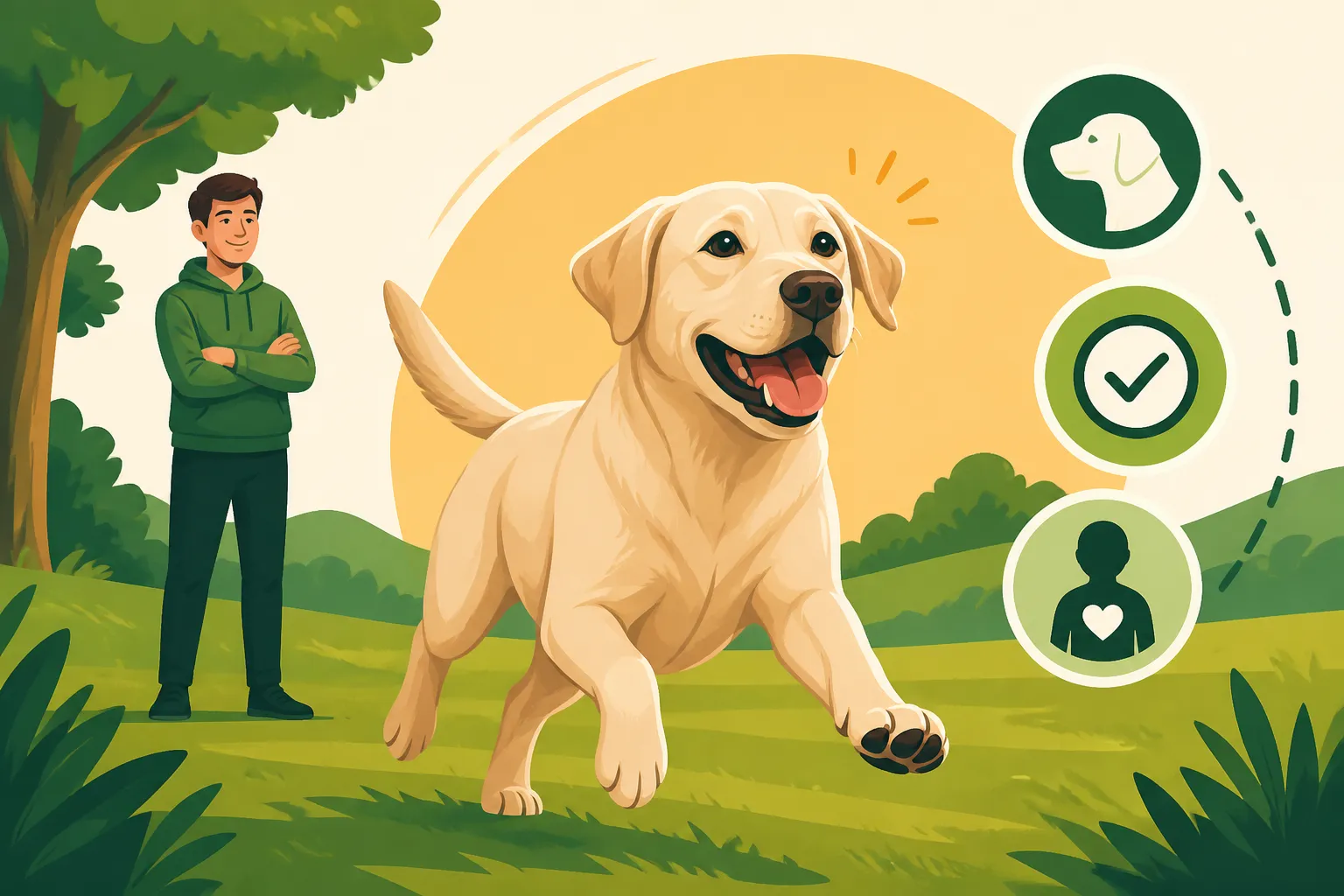
When a Labrador Can Be Trusted Off Leash
One of the biggest dreams for many Labrador owners is the freedom of letting their beloved dog roam off-leash, happily exploring while still returning instantly to a call. But let's be honest, the reality often looks more like a frantic chase after a disappearing tail when a squirrel appears, or an embarrassing shouting match in the park. This guide is all about helping you understand the complex journey to reliable off-leash trust with your Labrador, laying out the practical steps and realistic expectations so you can both enjoy safe, joyful adventures.
The Lure of Off-Leash Freedom And Why It's So Tricky for Labradors
There's nothing quite like watching a Labrador bound through an open field, ears flopping, tail wagging, truly experiencing pure joy. It’s a vision many of us hold dear when we bring a puppy home. But the path to that idyllic scene is often paved with challenges, primarily because Labradors, for all their biddability and desire to please, are still dogs with powerful instincts. It's not about them being naughty; it's about their inherent Labrador-ness.
Understanding the Labrador's Natural Drives
Labradors were originally bred to retrieve game for hunters, often working far from their handlers in difficult terrain. This means they possess incredible scenting abilities and a strong prey drive. While your Lab might be a perfectly docile family pet, that deep-seated instinct to chase a fleeing rabbit or follow an intriguing scent trail can override even the best intentions. Imagine your dog's nose catching a whiff of something utterly fascinating – perhaps a deer that passed by an hour ago – and suddenly, your voice becomes background noise. They're not being disobedient; they're simply being a Labrador, wired to follow that incredible olfactory world. This is why building reliable recall is less about demanding compliance and more about making you the most rewarding thing in their environment.
Another factor is their boundless energy and enthusiasm. A young Labrador, especially, is often experiencing the world at full throttle. Every new smell, sound, and sight is an invitation to explore. This natural curiosity, combined with their retrieve drive, can make them bolt towards anything that moves or smells interesting. Even a well-trained Lab can have a momentary lapse when an unexpected distraction, like a rogue plastic bag blowing across the park, triggers that chase instinct. It's crucial to acknowledge these powerful drives and train with them in mind, rather than against them.
The Misconception of "Good" vs. "Reliable" Recall
Many Labrador owners will confidently tell you their dog has "good recall." This often means their dog comes when called in the living room, in the backyard, or even at the quiet local park when no other dogs or people are around. That's a fantastic start, truly! But "good" recall in a low-distraction environment is a world away from "reliable" recall in the face of genuine, high-value distractions.
Reliable recall means that when your Labrador is immersed in the most exciting thing possible – say, chasing a ball with another dog, sniffing a really interesting patch of grass, or even seeing a person they desperately want to greet – they will still stop, turn, and come racing back to you the first time you call. This level of reliability is built over months, even years, of consistent, patient training in a wide variety of environments. It requires proving to your dog, repeatedly, that returning to you is always the best decision, no matter what else is going on. It's about developing an unbreakable habit, not just a learned command.
Building the Foundation: Essential Steps Before Even Thinking Off-Leash
Before you even dream of unclipping that leash in an unfenced area, there are fundamental steps that need to be firmly in place. Think of it like building a house: you wouldn't start framing the walls before pouring a solid foundation. The same goes for off-leash trust with your Labrador.
Mastering Basic Obedience Beyond "Sit"
While "sit" and "stay" are excellent starting points, truly reliable off-leash work requires a deeper commitment to obedience. The "come" command, or recall, is obviously paramount. This isn't just a casual invitation; it needs to be an instant, enthusiastic response. Start practicing in a distraction-free environment, like your home, then move to your yard, and gradually introduce more stimulating locations. Use upbeat, happy tones, and always reward lavishly when your dog returns. Never punish your dog when they eventually come, even if it took a while – that will only teach them to avoid coming back. Instead, make coming to you the most wonderful thing in their world. You want them to sprint to you like you're handing out gold.
Beyond recall, other commands are vital. A rock-solid "stay" or "wait" can be a lifesaver, allowing you to create distance or safety when a car or another dog approaches unexpectedly. A "leave it" command can prevent your Labrador from investigating something dangerous or irresistible on the ground. These commands need to be practiced until they are ingrained, becoming automatic responses rather than optional requests. Think about enrolled in an online program like BAXTER & Bella, where they break down these essential commands into easy-to-follow steps, often focusing on positive reinforcement to build that strong foundation.
The Power of a Strong Relationship and High-Value Rewards
At the heart of any successful training program, especially for off-leash reliability, is the bond you share with your Labrador. Your dog needs to see you as the source of all good things, the most interesting and rewarding presence in their life. Play games together, engage in positive reinforcement training, and simply spend quality time connecting with your dog. A dog that trusts and enjoys being with you is far more likely to choose you over a fleeting distraction.
When it comes to rewards, forget plain old kibble for high-stakes training like recall. You need high-value treats – something truly irresistible to your Labrador. Think small pieces of cooked chicken, cheese, hot dogs, or specialized training treats they only get for exceptional responses. These act as powerful motivators, making the act of returning to you incredibly worthwhile. Explore different options to find what truly motivates your specific Labrador; what one dog considers high-value, another might not. Treats That Motivate a Food-Driven Labrador often discusses various options that can make your training sessions far more effective and exciting for your furry friend. Remember, the goal is to be more exciting and rewarding than anything else in the environment.
The Gradual Journey to Off-Leash Trust
You’ve mastered basic obedience and built a fantastic bond. Now comes the exciting, yet meticulous, phase of transitioning towards off-leash freedom. This is not a "flip the switch" moment; it's a careful, calculated progression.
Starting with a Long Line Your Best Friend in Training
The long line is arguably the most indispensable tool for building off-leash reliability. It allows your Labrador to experience the illusion of freedom while you maintain a physical connection and control. Start with a 10-foot line, and once your Labrador is consistently responding well, move up to 20, 30, or even 50 feet. Practice your recall commands while your dog is on the long line, letting them roam a bit, then calling them back. If they hesitate, gently reel them in, rather than pulling them abruptly. The goal is for them to feel the option to ignore you but choose not to.
The beauty of the long line is that it eliminates the risk of your dog truly running off. You can let them explore, sniff, and even run a little, all while knowing you can intervene if they decide to ignore your call. This builds confidence in both you and your dog. As you progress, you'll find that the long line becomes less about physically controlling them and more about acting as a safety net. You can find durable long lines of various lengths and materials on platforms like Amazon, making it easy to experiment and find what works best for your training style and your dog's size. Long Line Work to Build Labrador Recall delves deeper into the techniques and benefits of using this vital tool, emphasizing how it bridges the gap between leashed and off-leash reliability.
Controlled Environments: Fenced Areas and Low-Distraction Zones
Once you're comfortable with the long line, the next step is to introduce very controlled, low-distraction, fenced off-leash environments. Think of a securely fenced dog park during off-peak hours, a friend's large, secure backyard, or a rented private field. The key here is complete containment and minimal distractions. In these environments, you can practice your recall without the fear of your Labrador disappearing into the sunset.
Gradually, introduce very minor distractions. Perhaps a friend stands a little distance away, or you scatter a few pieces of kibble on the grass, then call your dog away from them. The emphasis is on setting your Labrador up for success. If they fail, the environment was too distracting, not that your dog is "bad." Always keep training sessions positive, short, and fun. Never push your dog beyond their current comfort level, as this can lead to frustration and a breakdown in trust. Remember, every successful recall reinforces the behavior you want.
Introducing Controlled Distractions Safely
This is where the rubber meets the road. Once your Labrador is consistently responding to recall in controlled, low-distraction, fenced areas, you can begin to gradually introduce more real-world distractions. This requires careful planning and observation. Start by working near, but not directly in, an area with mild distractions. For instance, practice in a quiet corner of a park while other dogs are playing further away.
As your dog’s reliability grows, you can move closer to distractions or introduce them one by one. Have a friend walk by with their dog on a leash while your Lab is on a long line, and practice recall. Or throw a toy, let your Lab go for it, then call them back before they fully engage with the item. It’s a game of incremental challenges, always ensuring you can manage the situation and guarantee success. This phase requires immense patience and a keen eye for your dog's thresholds. The goal is to build resilience and responsiveness in the face of increasingly tempting scenarios. You are essentially teaching your Labrador to tune out the world and tune into you, no matter what.
Signs Your Labrador Might Be Ready And What Still Needs Work
It's tempting to want to declare your Labrador "off-leash ready" as soon as they've had a few good recalls. But true off-leash trust is a profound responsibility, and it's essential to be rigorously honest about your dog's preparedness.
Consistent Recall in Challenging Situations
The hallmark of an off-leash ready Labrador is consistent recall, not just "most of the time" but almost every time, even when faced with significant distractions. This means they respond promptly and enthusiastically when called away from other dogs, tempting scents, moving objects (like joggers or bikes), and new people. If you still have moments where your Labrador "tunes you out" for more than a second or two, or if you have to call them multiple times, they are not yet reliably off-leash.
Here’s a little checklist to gauge your Labrador's readiness. Be honest with yourself!
| Recall Scenario | Always Returns Promptly? | Sometimes Hesitates? | Often Ignores? |
|---|---|---|---|
| In a quiet, fenced backyard | Yes | ||
| With another dog playing nearby | Yes | ||
| While tracking an interesting scent | Yes | ||
| When someone new approaches | Yes | ||
| When a squirrel runs across the path | Yes | ||
| Near a busy road (from a safe distance) | Yes | ||
| When playing fetch with a favorite toy | Yes |
If you find yourself with anything other than "Yes" in the "Always Returns Promptly?" column for most scenarios, then there's still work to do. Consistency is key. You might also want to review When a Labrador Can Be Trusted Off Leash for more specific real-world examples of readiness tests.
Your Dog's Individual Temperament and Maturity
While training is crucial, your Labrador's innate temperament and maturity also play a significant role. Some Labradors, particularly those from field lines, have a naturally higher drive and a stronger tendency to range, making off-leash work more challenging. Others, often from show lines, might be naturally calmer and more inclined to stick close. Age is also a factor; a boisterous adolescent Labrador (often between 6 months and 2 years) is far more likely to be impulsive and test boundaries than a mature adult. When a Labrador Actually Calms Down discusses how their energy levels and focus shift as they age, which directly impacts their off-leash reliability.
It's also important to acknowledge that some Labradors, despite the best training efforts, may simply never be 100% reliable off-leash in all situations. This isn't a failure on your part or theirs; it's just their individual personality and genetic predispositions. For these dogs, a long line, a securely fenced area, or engaging activities where they are contained might always be the safest and most responsible approach. The most important thing is your dog's safety and your peace of mind. Celebrate the progress you make, and don't feel pressured to force a situation that isn't truly safe for your unique Labrador.
Ultimately, trusting your Labrador off-leash is a privilege earned through consistent training, unwavering patience, and a deep understanding of your dog's natural instincts. It's a journey, not a destination, and one that requires ongoing reinforcement.
Disclaimer
This article is for general informational purposes only and does not constitute professional advice. Laws, prices and regulations vary by location and change over time. Consult a qualified professional for guidance on your specific situation.